
Sordit Digital

Author name: devansh.c

Cookieless Lead Gen
Blog

Cookieless Lead Gen: Winning on Meta Ads After the Attribution Shift

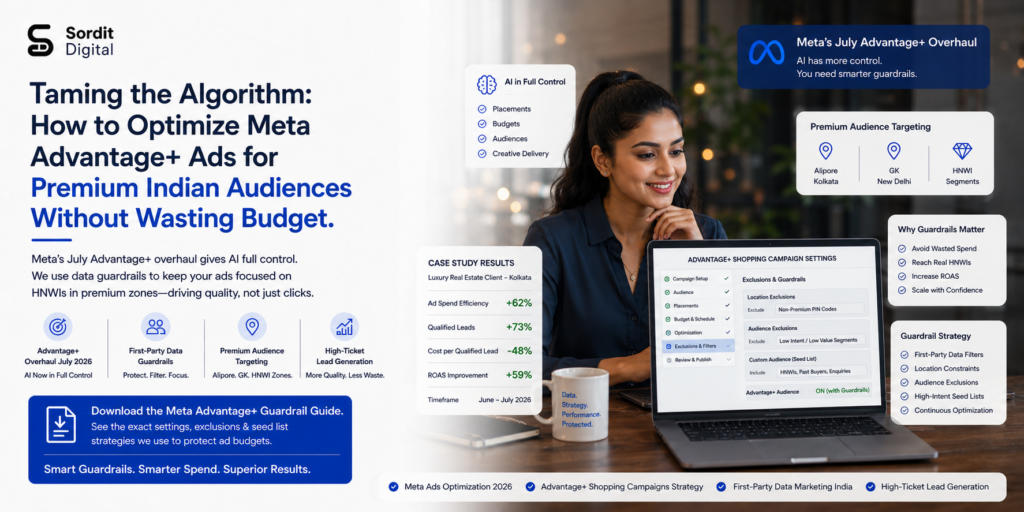
If you’ve looked at your Meta Ads Manager recently and noticed that your numbers look “different,” you aren’t imagining it. As of March 2026, Meta has fundamentally redefined how it tracks and reports success. We have officially entered the “Post-Cookie” reality where the traditional 7-day click attribution is no longer the sole source of truth. For brands at Sordit Digital, this shift is actually a massive opportunity. While your competitors are panicking over “lost” pixel data, you can win by mastering a cookieless advertising strategy. By pivoting to first-party data and native platform engagement, you can actually drive a lower Cost Per Lead (CPL) than ever before. 1. Understanding the 2026 Attribution Shift: Click-Through vs. Engage-Through The biggest change this year is the separation of “Clicks” from “Engagements.” Previously, Meta bundled likes, shares, and saves under the broad umbrella of click-through attribution. In the new 2026 model, these have been split into two distinct buckets: Click-Through Attribution: Now strictly refers to link clicks that lead to an external destination (like your website). This aligns Meta’s data more closely with Google Analytics. Engage-Through Attribution: This is the new powerhouse metric. It tracks conversions that happen after a user interacts with your ad without clicking the link—such as saving a Reel, sharing a post, or visiting your profile and then converting within 24 hours. Strategic Insight: In a cookieless world, “Engage-Through” is a high-intent signal. If a user saves your luxury interior design ad today and contacts you tomorrow, that is a direct result of your creative’s “stopping power,” even if they never clicked the “Learn More” button. 2. The Pillar of First-Party Data Marketing With third-party cookies effectively dead, your “Seed Lists” are your most powerful targeting tool. First-party data marketing involves using the information you own—email lists, CRM data, and phone numbers—to train Meta’s Advantage+ AI. Instead of asking Meta to “guess” who might want a digital marketing plan for FY 26-27, you upload your existing client list. Meta’s “Signal-Based Ranking” then finds people whose behaviors and profiles match your actual buyers. Actionable Step: Implement Meta’s Conversions API (CAPI). This creates a server-to-server connection that bypasses browser-based cookie blockers, recovering up to 30% of “lost” conversion data. 3. Slashing CPL with Instagram DM Automation for Business The most effective way to lower your CPL in 2026 is to stop sending people to your website. Every time a user leaves Instagram, you risk “drop-off” due to slow load times or privacy prompts. Instagram DM automation for business allows you to capture leads entirely within the app. By using “Comment-to-DM” triggers, you keep the user in a high-engagement environment where their data is already “authenticated” by Meta. Why this wins in 2026: Zero Friction: The user types “PLAN” and gets your PDF instantly in their inbox. Higher Open Rates: DM open rates in 2026 are hovering between 80% and 90%, far outperforming email. Instant Qualification: Your automation can ask, “What is your monthly marketing budget?” and only notify your sales team if the lead is high-value. 4. Meta Ads Lead Generation 2026: Creative is the New Targeting In a privacy-first world, you can’t rely on “interest-based” targeting as much as you used to. Today, your creative does the targeting. To succeed with Meta ads lead generation 2026, your videos must use a “Persona-Specific Hook” in the first 2 seconds. Example: “If you are a CEO in Kolkata planning your FY 26-27 budget…” The Result: The people who don’t fit that description scroll past. The people who do stay and watch. Meta’s AI notices this “Watch Time” and automatically finds more CEOs in Kolkata for you. 5. Winning the “Post-Cookie” Game A successful cookieless advertising strategy isn’t about finding a new way to “track” people—it’s about finding a better way to engage them. By focusing on first-party data, native DM funnels, and high-intensity creative, Sordit Digital helps brands move from “Stalking” to “Storytelling.” FAQs: Winning on Meta in 2026 Q: Why did my Click-Through conversions drop suddenly? A: They likely didn’t vanish; they were reclassified. Check your Engage-Through Attribution column. Many users now “save” an ad and come back to it via your profile or a direct search later. Q: Is Instagram DM automation safe for my brand? A: Yes, as long as you use Meta-approved API partners (like ManyChat or LinkDM). Automated DMs currently have the highest “Relationship Score” in the 2026 algorithm. Q: How do I start with First-Party data marketing? A: Start by cleaning your CRM. Ensure you have consented email addresses and phone numbers. Upload these as a “Custom Audience” in Meta to create high-accuracy Lookalikes. Is your CPL creeping up? Explore our Home Page to see how Sordit Digital can architect a native, cookieless funnel that turns your DMs into a lead-generation machine.

Human-to-Human (H2H) Premium
Blog

The “Human-to-Human” (H2H) Premium: Beating AI Content Fatigue in 2026

By April 2026, the digital marketing world has reached a “synthetic ceiling.” The internet is currently saturated with AI-generated text that is grammatically perfect but emotionally bankrupt. For B2B buyers, this has led to a massive wave of AI content fatigue. When every LinkedIn post and blog article feels like it was squeezed out of the same large language model, the only way to stand out is to be unapologetically human. This shift has given birth to the “Authenticity Premium.” In 2026, brands that win aren’t the ones with the best prompts, but the ones with the best people. Welcome to the era of Human-to-Human marketing (H2H). 1. Why H2H is the Only Cure for AI Content Fatigue In 2026, Google and LinkedIn’s algorithms have become experts at detecting pattern-based AI writing. LinkedIn’s latest “360Brew” algorithm now actively deprioritizes generic, template-style content. Users, too, have developed a “sixth sense” for AI-slop, scrolling past anything that lacks a unique perspective or a personal voice. Human-to-human marketing (H2H) is the strategic rejection of the “Corporate Voice.” It recognizes that even in the most complex B2B transactions, people buy from people they trust. The Trust Gap: According to recent 2026 trust barometers, 63% of consumers trust “people like me” (employees) more than corporate spokespeople. The Reach Gap: Personal LinkedIn profiles in 2026 receive roughly 10x the reach of company pages for the same piece of content. 2. Employee Advocacy ROI: Your People are Your Best Channel If your human-to-human marketing (H2H) strategy doesn’t include your team, it isn’t H2H—it’s just a solo act. Employee advocacy ROI has become a primary KPI for B2B firms this year. When your lead developer shares a “Lesson Learned” post or your Project Manager shares a “Behind-the-Scenes” look at a client site, they are building a bridge of trust that no banner ad could ever construct. The Numbers Behind Advocacy Lead Quality: Leads sourced through employee advocacy convert 7x more frequently than cold leads. Cost Efficiency: Advocacy programs are effectively “Organic PR,” reducing the reliance on increasingly expensive paid social channels. Retention: Employees who are encouraged to build their personal brands are 20% more likely to stay with their company. 3. Mastering Authentic B2B Storytelling The “Problem-Solution” case study is dead. In 2026, it has been replaced by authentic B2B storytelling. People want to hear about the “Messy Middle”—the parts where things went wrong, the pivots you made, and the human intuition that saved the day. How to Tell an Authentic H2H Story: Stop Sanitizing: If a project was difficult, say so. AI only writes about “Seamless Integrations.” Humans write about “3 AM Debugging Sessions.” Focus on “Micro-Moments”: Don’t just talk about the $1M result. Talk about the specific conversation with the client that sparked the breakthrough. Use Native Video: A 60-second, unpolished video from a smartphone is 2026’s version of a high-gloss commercial. It proves you are a real person in a real office. 4. The 2026 LinkedIn Algorithm: People Over Pages The 2026 LinkedIn algorithm update has made it clear: Personal Profiles are the priority. The platform has moved toward “Topic DNA,” where it evaluates the expertise of the individual rather than the size of the company. Dwell Time is King: The algorithm measures how long people stay on your post. Deep, nuanced authentic B2B storytelling keeps people reading longer than short AI bullet points. Penalizing External Links: To keep the “Human” conversation going, LinkedIn heavily deprioritizes posts that try to drive users off-platform immediately. Topic Authority: Consistently posting about 2-3 specific niches for 90 days signals to the AI that you are a human expert, not a generic bot. 5. Turning H2H into Revenue at Sordit Digital At Sordit Digital, we don’t just optimize for search engines; we optimize for humans. Our human-to-human marketing (H2H) approach ensures that when a prospect lands on your site or sees your team on LinkedIn, they feel an immediate sense of connection. We help our clients bridge the gap between “Digital Presence” and “Human Trust” through: Founder-led content coaching. Employee advocacy workshops. Story-driven content audits. FAQs: Navigating H2H in 2026 Q: Can I still use AI to write my posts? A: Use AI for the skeleton (research, outlining), but never for the soul. The final 20%—the stories, the tone, and the opinions—must be 100% human. Q: What is a good Employee Advocacy ROI for a small agency? A: You should look for a 3-5x increase in organic reach and at least a 15% increase in “Inbound Inquiry” quality within the first 6 months. Q: How often should my team post for H2H to work? A: Quality beats quantity. Two high-value, authentic stories per week are better than daily AI-generated posts that contribute to AI content fatigue. Is your brand feeling a bit “robotic” lately? Explore Us to see how we can inject H2H authenticity back into your marketing strategy.

Mastering Generative Engine Optimization
Blog

Mastering Generative Engine Optimization (GEO): Beyond Keywords in 2026

If you are still obsessing over whether your keyword appears in the first 100 words of your blog, you are playing a game from 2023. In April 2026, the rules of visibility have shifted. With Google’s AI Overviews (SGE) now appearing in nearly 50% of all search queries, the goal is no longer just to rank—it is to be cited. Welcome to the era of Generative Engine Optimization (GEO). At Sordit Digital, we’ve seen that traditional SEO is now just the foundation. To dominate the modern search landscape, you must optimize your content so that LLMs (Large Language Models) like Gemini, ChatGPT, and Perplexity don’t just “read” your site, but treat it as their primary source of truth. 1. GEO vs. SEO 2026: What’s the Real Difference? Traditional SEO was built on “Pull Marketing”—optimizing for a user to click a blue link. Generative Engine Optimization (GEO) and Answer Engine Optimization (AEO) are about “Synthesis Marketing.” The fundamental difference in AEO vs SEO 2026 lies in the delivery: Traditional SEO: Aims for a #1 position in a list of links. Success is measured by Click-Through Rate (CTR). GEO: Aims to be the “Cited Source” inside an AI-generated answer. Success is measured by “Share of Model” and citation frequency. If your content is synthesized into an AI answer but not cited, you provide value to the user but gain zero brand equity. GEO ensures your brand name and link are attached to the information provided. 2. The AI Overview Citation Strategy To be cited in an AI Overview, your content must be “Atomic.” This means it needs to be broken down into self-contained, fact-dense passages that an AI can easily extract. The “Direct-Answer” Framework AI models prioritize content that does the work for them. To implement a winning AI Overview citation strategy, follow this structure for every H2: Direct Statement: Answer the question in the first sentence. Supporting Data: Provide a statistic or a hard fact. Entity Context: Link the fact to a recognized authority or primary source. Example: Instead of saying “We have helped many doctors with SEO,” say “Sordit Digital’s healthcare SEO strategy has increased patient bookings by an average of 34% for clinics in Kolkata as of Q1 2026.” 3. The Power of Information Density in Content In 2026, “Fluff” is the enemy of rankings. AI engines use a metric called Information Density in content. This isn’t about word count; it’s about the ratio of “unique facts” to “filler words.” High information density makes your content “sticky” for AI. When a model like Claude or GPT-5 scans your page, it looks for: Unique Data Points: Original research or proprietary case studies. Technical Specifications: Exact numbers, prices, and dimensions. Semantic Clarity: Using precise terminology (e.g., “Generative Engine Optimization”) instead of vague phrases (e.g., “New search stuff”). 4. Building “Entity Authority” Over “Link Juice” In the GEO world, who you are matters more than how many links you have. Google now uses “Entity Resolution” to verify if a source is trustworthy. Verified Authorship: Every piece of content on Sordit Digital is linked to a verified professional profile. Unlinked Brand Mentions: AI models track how often your brand is mentioned across Reddit, Quora, and industry news—even without a backlink. These mentions build your “Entity” strength in the eyes of the AI. 5. Transitioning from “Search” to “Answer” As you optimize your pages, ask yourself: “If a user never clicks through to my site, did they still learn that Sordit Digital is the expert?” By mastering Generative Engine Optimization (GEO), you aren’t just fighting for traffic; you are fighting for the “Brainspace” of the AI models your customers use every day. FAQs: Mastering GEO in 2026 Q: Is SEO dead? A: No. SEO is the prerequisite for GEO. An AI cannot cite a page it cannot crawl or trust. You need a strong Technical SEO foundation before you can win at GEO. Q: How do I track GEO success? A: Look for “Synthesis Impressions” in your 2026 Search Console and monitor your “Share of Model” using AI tracking tools to see how often your brand is cited compared to competitors. Q: Does content length matter for GEO? A: Structure matters more than length. A 500-word post with high information density in content will often out-cite a 3,000-word “fluff” article. Does your current website provide enough “Information Density” to be cited by AI? Explore Sordit Digital to see how we can re-architect your content for the Generative Era.

Digital Marketing Plan for FY 26-27
Blog

Digital Marketing Plan for FY 26-27: Navigating the Agentic Era of Marketing

Welcome to April 2026. In India, this month marks more than just the start of a new financial year; it marks the official transition into the “Agentic Era” of business. For CEOs, founders, and marketing directors, the traditional playbook of simply “ranking for keywords” or “running social ads” is being replaced by a more sophisticated reality: a world where AI doesn’t just suggest—it executes. As you finalize your digital marketing plan for FY 26-27, the focus must shift from manual tactics to autonomous systems. In this guide, we will break down the strategic pillars required to dominate the next twelve months, ensuring your brand is prepared for a landscape where your primary “customer” might just be another AI agent. 1. What is the Agentic Era? The “Agentic Era” refers to the shift from generative AI (which creates content) to agentic AI (which takes action). In 2026, we are seeing the rise of agentic commerce trends where AI agents autonomously handle product discovery, price negotiations, and even transaction completions. For a business, this means your website is no longer just a digital brochure for humans. It must serve as a data hub that AI agents can crawl to make decisions. If your digital marketing plan for FY 26-27 doesn’t account for machine-to-machine interactions, you are missing out on the fastest-growing segment of the economy. 2. Strategic B2B Marketing Strategy 2026 In the B2B sector, the sales funnel has collapsed. Decision-makers no longer want to sit through ten discovery calls. They are using specialized AI agents to vet vendors, compare service SLAs, and check for compliance before ever reaching out to a human. The Rise of Account-Based Experiences (ABX) A modern B2B marketing strategy 2026 must prioritize “Intent Data” over “Lead Forms.” Instead of waiting for someone to download a whitepaper, we use predictive analytics to identify companies that are currently searching for your services. We then serve hyper-personalized content—often human-led (H2H) videos—directly to those stakeholders on LinkedIn and specialized professional networks. 3. Marketing Budget Allocation 2026: The 70/20/10 Rule With the costs of paid acquisition rising, smart marketing budget allocation 2026 is about balance and “owned” channels. Here is how Sordit Digital recommends dividing your spend for the new financial year: 70% on Proven Channels (The Foundation): Focus on SEO, email marketing, and high-intent PPC. These remain the highest ROI drivers. (Check our services page for how we optimize these core pillars). 20% on Growth Opportunities (The Horizon): Invest in agentic commerce trends and Answer Engine Optimization (AEO). This is where you prepare your site to be “cited” by AI. 10% on Innovation (The Edge): Experiment with interactive short-form video and AR-led commerce experiences. 4. From SEO to GEO: Generative Engine Optimization The core of your digital marketing plan for FY 26-27 must be Generative Engine Optimization (GEO). Since nearly 40% of search traffic in 2026 flows through “Answer Engines” like Perplexity and Gemini, your content needs to be “machine-readable.” Information Density: AI engines favor content that provides direct, factual answers. Third-Party Consensus: To be recommended by an agent, your brand needs consistent mentions across Reddit, Quora, and industry-specific review platforms. Structured Data: Comprehensive Schema markup (JSON-LD) is now more important than your meta description. 5. The “Authenticity Premium” (H2H) In an era of “AI slop,” human connection is your competitive advantage. While AI handles the execution, humans must handle the conviction. Your B2B marketing strategy 2026 should empower your employees to be the face of the brand. Founder-led videos and employee advocacy programs on LinkedIn are currently seeing 8x the engagement of corporate brand posts. FAQs: Planning for FY 26-27 Q: Why is my organic traffic dropping despite high rankings? A: You are likely experiencing “Zero-Click Search.” AI is answering the user’s question on the search page. To fix this, you need to optimize for “Brand Citations” within the AI overview rather than just blue links. Q: How much should a startup in India spend on marketing in FY 26-27? A: Generally, marketing budget allocation 2026 for startups is between 12-20% of projected revenue to gain market share, while established SMBs typically spend 7-12%. Q: What is the most important technical fix for 2026? A: WebMCP readiness. Ensuring your website has the proper manifests and structured data to allow AI agents to interact with your booking or inventory systems. Final Thoughts: Act Fast or Fall Behind The transition to an agentic world is the most significant transformation in commerce since the dawn of the internet. By building a digital marketing plan for FY 26-27 that balances human authenticity with machine-ready data, you aren’t just surviving the shift—you are leading it. Ready to dominate the new financial year? Explore our Home Page to see how Sordit Digital can architect your growth strategy for 2026 and beyond.

Healthcare SEO Strategy 2026
Blog

Healthcare SEO Strategy 2026: Winning Local Patients with E-E-A-T

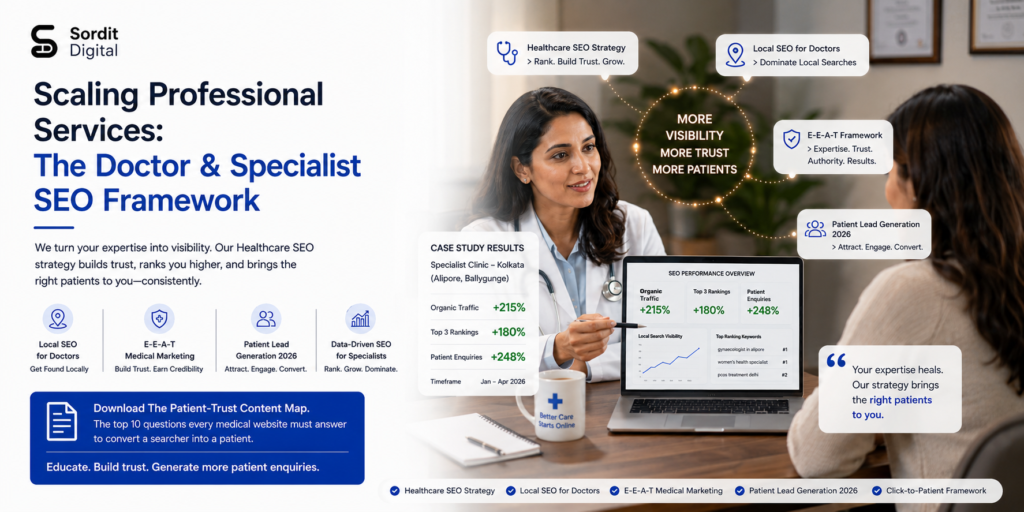
For medical professionals, the digital landscape of 2026 is no longer just about “being found”—it is about “being trusted.” Google’s algorithms have become incredibly sophisticated at identifying “Your Money or Your Life” (YMYL) content. If you are a doctor, a clinic owner, or a hospital administrator, a generic website is now a liability. In 2026, a winning healthcare SEO strategy requires more than just keywords; it requires a deep integration of medical authority and hyper-local precision. To turn searchers into patients, your practice must prove its expertise before the first appointment is even booked. 1. The Foundation of E-E-A-T Healthcare SEO In the medical field, Google prioritizes E-E-A-T healthcare SEO: Experience, Expertise, Authoritativeness, and Trustworthiness. In 2026, “AI-generated medical fluff” is actively penalized. Google wants to see that your content is written or verified by a credentialed professional. How to implement E-E-A-T for your clinic: Verified Author Bios: Every blog post or service page should have a clear author box linked to the doctor’s LinkedIn profile, NPI number, and medical board certifications. Content Citations: Back up every medical claim with links to peer-reviewed journals or official health organizations (like the WHO or ICMR). Video Explainers: A 30-second video of a doctor explaining a procedure provides “Experience” and “Trust” that text alone cannot match. 2. Dominating with Hyper-Local SEO for Doctors In 2026, ranking for “Best Cardiologist in India” is a waste of resources for a local clinic. Patients search for convenience. Your local SEO for doctors must target “Micro-Locations”—the specific neighborhoods, blocks, and landmarks surrounding your clinic. The “Zero-Distance” Strategy Patients now use voice search and AI agents to find “the nearest pediatrician open now.” To win these searches: Google Business Profile (GBP) Mastery: Ensure your GBP is updated daily with “Clinic Updates,” photos of your waiting room, and real-time holiday hours. Neighborhood-Specific Landing Pages: If your clinic is in Salt Lake, Kolkata, create content specifically for residents of Sector I, II, and III. Mention local landmarks and nearby pharmacies to signal “Local Relevance” to Google. 3. Medical Practice Marketing: Beyond the Search Bar Effective medical practice marketing in 2026 bridges the gap between a search result and a scheduled surgery. Your website must act as a digital “Front Desk.” Integrated Booking Systems: If a patient finds you via a healthcare SEO strategy, they should be able to book an appointment directly from the search result or your landing page without picking up the phone. Patient-Centric FAQs: Use your blog to answer the real questions patients ask in the exam room: “How long is the recovery for X?” or “Does my insurance cover Y?” These “Long-Tail” queries are the easiest way to rank #1. 4. Reputation Management as an SEO Signal In 2026, reviews are not just for social proof; they are a direct ranking factor. Google’s AI analyzes the sentiment and keywords within your patient reviews. If multiple patients mention your clinic is “the best neurosurgeon for migraine treatment,” Google will automatically begin ranking you higher for “migraine treatment” searches in your area. Encouraging patients to leave detailed, keyword-rich reviews (within ethical and HIPAA/legal guidelines) is a core pillar of modern local SEO for doctors. 5. The Future: Voice Search and AI Medical Assistants As we look toward the end of 2026, more patients are using AI assistants to “find a doctor who takes my insurance and has an opening this Friday.” A forward-thinking healthcare SEO strategy involves using “Structured Data” (Schema Markup) to tell these AI agents exactly what your specialties are, what insurance you accept, and what your real-time availability is. At Sordit Digital, we ensure your technical backend is as healthy as your patients. Final Checklist for Your 2026 Healthcare Strategy Audit your practice’s digital health against these four pillars: Expert Verification: Are all your medical pages signed off by a verified doctor to satisfy E-E-A-T healthcare SEO? Hyper-Local Focus: Does your website mention the specific neighborhoods and landmarks around your clinic? Speed and Accessibility: Does your site load in under 2 seconds on a mobile device? (Patients in pain are not patient with slow sites). Review Consistency: Do you have fresh, positive Google reviews from within the last 30 days? Conclusion Winning patients in 2026 is about proving you are the most trusted local authority before the patient ever walks through your door. By combining healthcare SEO strategy with a focus on local relevance, Sordit Digital helps your practice grow while you focus on what matters most: patient care.

Short-Form Video Marketing 2026
Blog

Short-Form Video Marketing 2026: Why Visual Brands Must Shift to Interactive Content

For years, “visual brands”—luxury interior designers, high-end salons, and premium e-commerce boutiques—thrived on a simple “Aesthetic Grid” strategy. A beautiful, static photo of a renovated living room or a perfectly styled haircut was enough to stop the scroll. But as we settle into 2026, the “Pretty Picture” era has officially ended. Algorithms have pivoted, and consumer attention spans have fragmented. Today, high-end brands are finding that their most beautiful photos are getting less reach than a raw, 15-second clip. To stay relevant, businesses must master short-form video marketing 2026, moving beyond pure aesthetics toward high-engagement, interactive storytelling. 1. The Death of the Static Aesthetic In the current landscape, “Visual” no longer means “Static.” The 2026 visual content marketing trends show a massive shift toward “Living Content.” Platforms like Instagram and TikTok now prioritize the “Time Spent” metric over the “Like” metric. A static image takes 1 second to view. A short-form video holds a user for 15 to 30 seconds. This signals to the algorithm that your content is valuable, pushing your brand into the feeds of thousands of new potential clients. For a luxury interior brand like ABS Decor, showing a “Before & After” transition in a 9:16 vertical format is now 5x more effective than a side-by-side photo post. 2. Implementing an Interactive Video Strategy The biggest breakthrough in 2026 isn’t just video—it’s interactive video strategy. Passive watching is being replaced by active participation. Brands that allow users to “choose their own adventure” or interact with the video are seeing a 40% higher conversion rate. How to make your videos interactive: Poll Hooks: Ask viewers to vote on a design choice (e.g., “Gold fixtures or Matte Black?”) directly within a Reel. Comment-to-DM Automation: Use keywords like “DESIGN” or “CATALOG” in your captions. When a user comments, an automated flow sends your portfolio or booking link directly to their inbox. Shoppable Hotspots: For e-commerce brands, 2026 technology allows users to tap a product inside a moving video to see the price and “Add to Cart” without leaving the app. 3. Dominating Instagram Reels for Business in 2026 While many platforms exist, Instagram Reels for business remains the gold standard for high-ticket service industries. However, the way we use Reels has changed. In 2026, the “Polished Commercial” is out; “Authentic BTS (Behind the Scenes)” is in. People want to see the process, the personality, and the expertise behind the brand. The “Expert Voiceover”: Instead of just trending music, use original audio to explain why a certain material was chosen for a project. Micro-Vlogs: A 20-second “Day in the Life of a Marketing Consultant” or “Morning at the Salon” builds a human connection that a logo never could. 4. The ROI of Engagement vs. Views Many brands get distracted by “Viral Views.” In short-form video marketing 2026, Sordit Digital focuses on “Conversion Views.” A video with 1,000 views from local residents in Kolkata who interact with a poll is infinitely more valuable than a video with 100,000 global views that results in zero inquiries. By focusing on an interactive video strategy, you are filtering your audience. Only the people truly interested in your service will take the time to interact, providing you with a list of high-intent leads ready for follow-up. 5. Visual Content Marketing Trends: What’s Next? As we look toward the second half of 2026, we are seeing the rise of Augmented Reality (AR) Video Filters. Imagine a salon allowing a client to “try on” a hair color through a video filter before booking, or an interior designer letting a client “place” a sofa in their room via a 3D video hook. Brands that start mastering basic short-form video today will be the only ones equipped to handle these advanced visual technologies tomorrow. Final Checklist for Your Video Strategy To ensure your visual brand doesn’t get left behind, audit your content against these four pillars: Motion First: Is at least 80% of your feed dedicated to short-form video marketing 2026? The Interaction Hook: Does every video give the user something to do (Vote, Comment, Tap)? Vertical Optimization: Are you filming exclusively in 9:16 to maximize screen real estate on Instagram Reels for business? Value over Polish: Are you providing a “Takeaway” (a tip, a laugh, or a transformation) in every clip? Conclusion Aesthetics get people to look, but interaction gets people to buy. By shifting your focus from “looking good” to “engaging deeply,” Sordit Digital helps your brand dominate the digital landscape. Don’t just show them your work—make them a part of it.

Cookieless Advertising Strategy
Blog

Cookieless Advertising Strategy: Getting Cheaper Leads in a Post-Cookie World

For over a decade, digital advertisers relied on a “magic pixel” to track every move a customer made across the web. But as we reach the midpoint of 2026, that era has officially ended. With the total phase-out of third-party cookies across all major browsers and the tightening of global privacy laws, the old way of targeting is dead. If you’ve noticed your Cost Per Lead (CPL) spiking or your conversion tracking becoming “blurry,” you aren’t alone. However, the most successful brands aren’t panicking—they are pivoting. By adopting a robust cookieless advertising strategy, Sordit Digital is helping clients move away from “tracking” and toward “predicting.” 1. The Shift to First-Party Data Marketing In a world without third-party cookies, your internal database is your most valuable asset. First-party data marketing is the practice of using information your customers have given you directly—emails, phone numbers, and past purchase behaviors—to fuel Meta’s AI. In 2026, Meta’s “Advantage+ Custom Audiences” perform best when they have a “Seed List” to learn from. Instead of asking Meta to “find people interested in interior design,” we upload a hashed list of your existing high-value clients. Meta’s AI then finds “Lookalike” profiles based on real, verified humans rather than unstable browser cookies. 2. Meta Ads Lead Generation 2026: The Rise of On-Platform Conversions One of the biggest mistakes brands make in a Facebook ads post-cookie landscape is trying to send every user to an external landing page. Every time a user leaves the Meta app, you lose a massive chunk of tracking data. To lower your CPL, your Meta ads lead generation 2026 strategy must focus on “Native Conversions.” Instant Forms: Meta’s built-in lead forms keep the user inside the app, ensuring 100% accurate data attribution. WhatsApp & Messenger Automation: By driving traffic directly into a chat, you capture a lead’s phone number and intent instantly, bypassing the need for a tracking pixel entirely. 3. Creative as the New Targeting Since we can no longer rely on granular technical tracking, we must rely on “Creative Targeting.” In a cookieless advertising strategy, your ad creative (the video or image) acts as your filter. If your ad starts with “Are you a luxury homeowner in Alipore looking for a kitchen remodel?”, the people who keep watching are your target audience. Meta’s AI tracks this “Watch Time” and automatically shows the ad to similar people. 9:16 Vertical Video: The dominant format for 2026. The 3-Second Hook: If you don’t call out your specific audience immediately, you waste budget on the wrong clicks. 4. Implementing the Conversions API (CAPI) If you must send traffic to your website, the standard browser pixel is no longer enough. To survive Facebook ads post-cookie, you must implement the Conversions API (CAPI). CAPI creates a “Server-to-Server” connection. Instead of the user’s browser telling Meta a sale happened (which can be blocked by privacy settings), your website server tells Meta directly. This recovers up to 30% of “lost” data, immediately improving your ad optimization and lowering your CPL. 5. Why Privacy-First is a Competitive Advantage Many businesses see privacy as a hurdle. At Sordit Digital, we see it as an opportunity. Brands that respect user privacy and focus on first-party data marketing build deeper trust. When you stop “stalking” users with creepy retargeting ads and start providing value through high-quality content and direct communication (like newsletters or SMS), your brand authority skyrockets. Final Checklist for Your 2026 Meta Strategy To ensure your ads remain profitable in this new era, verify these four pillars: Direct Integration: Is your Conversions API (CAPI) sending a “High Match Quality” score? Lead Magnets: Are you offering enough value (Free E-books, Consultations) to get users to share their first-party data? Broad Targeting: Are you trusting Meta’s AI to find your audience based on your cookieless advertising strategy? Short-Form Video: Are you producing at least 2-3 new video hooks per week to prevent ad fatigue? Conclusion The “Cookie Apocalypse” isn’t the end of digital advertising; it’s the beginning of a more honest, data-secure relationship with your customers. By mastering a cookieless advertising strategy, Sordit Digital ensures that your brand stays ahead of the curve while your competitors are still trying to fix their broken pixels.

Zero-Click Search Optimization
Blog

Zero-Click Search Optimization: The 2026 Strategy for B2B & Service Brands

For years, the formula for digital marketing was simple: rank on page one, get the click, and convert the user on your website. However, as we move through 2026, that formula has fundamentally broken. Many B2B and service-based business owners are noticing a terrifying trend: their keyword rankings are as high as ever, yet their organic traffic is plummeting. Welcome to the era of the “Zero-Click” search. With Google’s Search Generative Experience (SGE) and AI-powered engines like Perplexity providing instant, comprehensive answers directly on the results page, users no longer need to click through to your website to get what they need. To survive, your agency needs to pivot. Here is how to master zero-click search optimization to ensure your brand remains the authority that the AI cites. 1. Understanding the Shift to Generative Engine Optimization (GEO) In 2026, traditional SEO has evolved into Generative Engine Optimization (GEO). While SEO focused on keywords and backlinks, GEO focuses on “Source Credibility” and “Information Density.” AI models don’t just look for keywords; they look for the most reliable source to summarize for the user. To win the zero-click battle, your content must be structured in a way that AI agents can easily parse. Be the Direct Answer: Use clear, declarative sentences. Instead of “We offer a variety of SEO services that might help your business,” use “Our SEO services include technical audits, backlink building, and content strategy.” Structured Data is Non-Negotiable: Use advanced Schema markup to tell AI exactly what your data means. Whether it’s pricing, service areas, or FAQs, structured data is the “language” AI speaks. 2. Refining Your B2B SEO Strategy for 2026 A successful B2B SEO strategy 2026 is no longer about chasing high-volume “vanity” keywords. It is about capturing “High-Intent Micro-Moments.” In the B2B sector, the sales cycle is long and involves multiple stakeholders. When a CEO asks an AI, “What is the ROI of a specialized marketing consultant for an interior design firm?” you want the AI to pull that answer from your blog. Focus on High-Value “Niche” Clusters Don’t just target “digital marketing.” Target “digital marketing for luxury interior decor in Kolkata.” By going hyper-niche, you become the definitive source for that specific segment, making it more likely that the AI will pull your data for zero-click answers. 3. Dominating AI Search Engine SEO AI search engine SEO requires a shift from “Writing for Humans” to “Writing for Authority.” When Google or Perplexity generates a summary, they look for citations. Your goal is to be the citation. To increase your citation rate: Original Data & Research: AI loves facts. If Sordit Digital publishes an original study on “Average Lead Cost for Interior Designers in 2026,” every AI engine will cite that study when asked about lead costs. The “E-E-A-T” Factor: Experience, Expertise, Authoritativeness, and Trustworthiness are more important than ever. Ensure every blog post is attributed to a real expert (like MD Anwar) with a verified LinkedIn profile and a history of industry contribution. 4. The Power of “Information Density” In the zero-click world, brevity is a weakness. AI models prefer “dense” content—pages that answer the primary question AND the next three logical questions a user might have. If you are writing about zero-click search optimization, don’t just define it. Explain: Why it’s happening now. How to measure it in Search Console. The specific HTML tags that help AI crawl your site better. How it differs for B2B vs. B2C. This “Information Density” makes your page a “Mega-Source,” which AI engines prioritize when they need to provide a comprehensive summary to a user. 5. Turning “Zero-Clicks” into Brand Authority A zero-click search isn’t a “lost” lead; it’s a “Brand Impression.” If a potential client sees “Sordit Digital” cited as the expert source in a Google AI Overview three times in one week, they won’t need to click a link to know you are the leader in the field. When they are finally ready to hire an agency, they won’t search—they will come directly to your URL or find you on LinkedIn. Optimizing for zero-click means optimizing for trust. Final Checklist for 2026 SEO Success To ensure your content is fully optimized for the current landscape, follow these rules: Primary Keyword Frequency: Ensure your primary keyword, such as zero-click search optimization, appears naturally (around 1% density) throughout the text. Optimize for Snippets: Use bullet points and numbered lists for “How-to” queries. Invest in Video: AI engines are increasingly pulling “Key Moments” from videos to answer search queries. Update Frequently: AI favors fresh data. A blog post from 2024 is considered “dead” to a 2026 AI engine. Conclusion The landscape of search has changed, but the goal remains the same: being the most helpful, most authoritative voice in the room. By embracing zero-click search optimization and refining your AI search engine SEO, Sordit Digital will not just survive the shift—you will lead it.

Medical Digital Marketing agency Sordit Digital is sharing , How to Build a Trustworthy Medical Website for Indian Clinics
Blog

How to Build a Trustworthy Medical Website for Indian Clinics

IntroductionIn today’s digital-first healthcare environment, your clinic’s website serves as your primary point of contact. Patients in India demand a credible, informative, and transparent online presence when choosing their healthcare provider. A trustworthy medical website builds stronger patient relationships, facilitates bookings, and sets your clinic apart—even before a patient walks through your door. ConclusionA trustworthy medical website is built on professionalism, transparency, real patient connections, data privacy, and expert content. For clinics serving the vast and diverse Indian healthcare market, focusing on these best practices means more bookings, lasting relationships, and stronger online reputation.Ready to build a medical website that establishes your clinic as a trusted leader? Contact Sordit Digital for a free audit and powerful healthcare web solutions today.

Effective Content Marketing for Medical Practices by halthcare expert digital marketing Agency Sordit Digital
Blog

Effective Content Marketing for Medical Practices

Introduction Indian patients today are actively researching health information online before making decisions. For medical practices, effective content marketing not only educates but also builds trust, boosts organic rankings, and moves the patient journey from awareness to appointment. Understanding the Indian Healthcare Audience Patients in India value information presented in clear, non-technical language. They seek answers on cost, safety, procedure details, recovery times, and real experiences, often preferring local language and cultural references. Top Content Types for Engagement Content Marketing Best Practices Keyword Research: Base topics on actual patient queries. Use Google Autosuggest, “People also ask,” and health keyword tools to target locally relevant terms. Content Calendar: Plan regular updates—one new blog and one new testimonial per week is a good start. SEO Optimization: Structure content with clear H1/H2s, meta tags, internal links, and keyword integration. Don’t forget image alt text and local focus. Mobile First: Most Indian patients access health info via mobile. Optimize every blog and feature for fast loading and responsive layout. Regional Languages: Consider Hindi, Tamil, Bengali, or other languages depending on your area for select guides or videos—the extra effort sets your practice apart. Internal and External Linking Internal: Guide users from blogs to service descriptions, doctor profiles, appointment forms, and testimonials. Cross-link related articles for increased dwell time. External: Reference trusted Indian health sites, regulatory boards, government standards, and authoritative medical news. Promoting & Sharing Content Use WhatsApp, email newsletters, and social media to share new articles. Partner with local media and community portals for guest articles. Collaborate with medical equipment suppliers or pharma for co-marketing. Tracking Success Monitor patient inquiries, appointment bookings, blog traffic, and social shares using Google Analytics, GMB Insights, and feedback forms. Adjust content topics and frequency based on performance data. Conclusion Content marketing is the tool that connects, educates, and converts Indian healthcare customers. By continuously providing valuable, accessible, and SEO-optimized information, your practice develops authority and organically grows patient trust and bookings. Ready to launch your content marketing strategy? Sordit Digital provides tailored blog plans, video campaigns, and SEO optimization for medical practices—contact us to start building your patient network today.