
Sordit Digital

Digital Marketing

Meta ads optimization 2026
Digital Marketing

Taming the Algorithm: How to Optimize Meta Advantage+ Ads for Premium Indian Audiences Without Wasting Budget

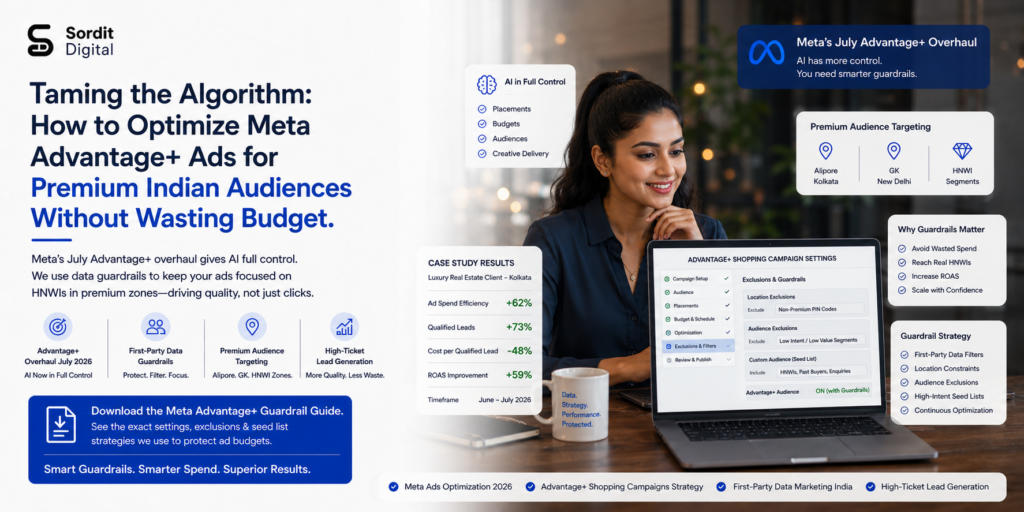
In July 2026, Meta rolled out its most aggressive system overhaul yet to Advantage+ Shopping Campaigns (ASC) and automated ad suites. The platform has effectively stripped away manual targeting levers, pushing media buyers into an AI-driven environment where placement, budget distribution, and creative matching are handled entirely by machine learning. For mass-market consumer brands selling low-ticket items, this automation can work wonders. But if your agency or brand manages luxury real estate, high-end interior design, specialized healthcare, or premium D2C products, Meta’s unguided algorithm is a profit killer. Without strict boundaries, Meta’s AI optimizes for the path of least resistance: cheap clicks and broad engagement. Your premium ad spend gets rapidly burned on accidental taps, bots, and aspirational scrollers across broad demographics, rather than reaching High-Net-Worth Individuals (HNWIs) in elite pockets like Alipore in Kolkata or Greater Kailash in Delhi. Executing effective Meta ads optimization 2026 requires taming the algorithm. At Sordit Digital, we don’t fight Meta’s machine learning—we give it strict guardrails using first-party data. 1. The July Advantage+ Trap: Why Unconstrained AI Burns Premium Budgets To protect your media spend, you must understand how Meta’s automated systems operate under the hood. An unconstrained Advantage+ shopping campaigns strategy relies on broad audience expansion. The algorithm prioritizes speed and volume, seeking out users who are mathematically most likely to click or comment on an ad format. The Automated Audience Drift: Broad Advantage+ Settings ➔ AI Targets Cheap/Broad Engagement ➔ Ad Budget Spent on Non-Buyers ➔ High Impressions / Zero High-Ticket Sales When selling high-ticket services or luxury products in India: Aspirational Click Bloat: Millions of users click on luxury home designs or premium cars out of curiosity, not buying power. The AI misinterprets these clicks as “positive intent” and floods your account with low-quality traffic. Placement Waste: Advantage+ automatically distributes budget across low-converting placement networks (like Audience Network or casual in-app games) to hit low Cost Per Click (CPC) targets. Geographic Bleed: Despite pin-code settings, automated expansion models often bleed into surrounding outer-suburban regions, wasting impressions on users outside your actual delivery or service zones. 2. Setting Up First-Party Data Marketing India Guardrails The key to keeping Meta’s AI focused on actual buyers is supplying it with clean, verified offline data. Implementing a robust first-party data marketing India framework transforms Meta’s algorithm from a wild guesser into a laser-guided sales machine. Instead of letting Meta guess who your ideal customer is based on platform interactions, you feed the system encrypted, high-value data signals directly from your CRM. How First-Party Guardrails Guide the AI: CAPI Server-to-Server Integration: Connect Meta’s Conversions API (CAPI) directly to your CRM (or payment gateways like Razorpay) to bypass browser-based cookie blocking and feed offline purchase events back to Meta in real time. Custom Seed List Exclusions: Upload custom audiences consisting exclusively of verified, high-LTV (Lifetime Value) buyers. Instruct the Advantage+ system to use this list as a strict “Seed” for Lookalike modeling, while explicitly excluding low-intent lead pools. Minimum Age & Postal Tier Filters: Enforce hard demographic minimums within your Advantage+ account controls, restricting delivery exclusively to validated high-income pin codes. 3. High-Ticket Lead Generation via Creative Qualification When targeting affluent Indian demographics, your ad creative must act as the primary filter. In a high-ticket lead generation campaign, the goal of your ad is not just to attract the right customer—it is to actively repel the wrong one. The Creative Filtering Blueprint: Explicit Localized Anchors: Open video reels with immediate text and verbal qualifiers: “Looking for a luxury interior architect in South Delhi?” or “Exclusive 4-BHK residences in Alipore.” Price Transparency: Explicitly state starting price points or project minimums within the first 3 seconds of the video or ad copy. This instantly deters low-budget clicks. Friction-Based Forms: When using native Instant Forms or DM funnels, introduce mandatory multi-choice qualifying questions (e.g., “What is your expected project budget?” or “When do you plan to begin construction?”) 4. How Sordit Digital Maximizes Your Performance Marketing ROI At Sordit Digital, we specialize in high-stakes performance marketing where every rupee must deliver measurable pipeline value. We help Indian brands master Meta ads optimization 2026 by pairing Meta’s powerful machine learning algorithms with custom data guardrails and hyper-local targeting strategies. By controlling geographic parameters, configuring CAPI backend architecture, and deploying high-converting creative frameworks, we keep your brand in front of genuine decision-makers in India’s wealthiest zip codes. Take Action: Contact Now Don’t let automated ad settings waste your performance budget on empty clicks. Take back control of your campaigns with our exact technical agency setup. The Meta Advantage+ Settings Guardrail Guide Stop letting Meta’s algorithm guess your target audience. This comprehensive technical PDF blueprint includes: Backend Exclusion Checklists: Step-by-step instructions to turn off low-value placement networks and prevent audience expansion bleed. High-Income Location Pin-Code Maps: Pre-mapped postal codes for top affluent zones across major Indian metros (Kolkata, Delhi NCR, Mumbai, Bengaluru). CAPI Data Setup Checklist: How to sync your CRM with Meta’s Server-Side API to feed the algorithm high-LTV purchase signals. FAQs: Advantage+ Ads & High-Ticket Targeting Q: Can Advantage+ Shopping Campaigns (ASC) really work for high-ticket services or B2B? A: Yes, but only if you use custom custom audience controls and CAPI server-side event tracking. Without first-party data guardrails, ASC will optimize for cheap engagement rather than qualified, high-ticket prospects. Q: Why are my leads coming from outside my specified target pin codes? A: By default, Meta’s automated Advantage+ settings enable “Audience Expansion,” which allows the system to deliver ads outside your chosen location if it believes it can find cheaper conversions. You must manually enforce strict location boundaries within your account’s structural settings. Q: What is the ideal daily budget needed to stabilize Meta’s AI learning phase in 2026? A: To clear Meta’s learning phase, an ad set needs roughly 50 conversion events per week. For high-ticket campaigns with higher CPLs, you should aggregate your budget into a simplified campaign structure rather than splitting it across multiple fragmented ad sets. Protect and Scale Your Ad Spend Today Stop

Festive marketing strategy India
Digital Marketing

Why July is the Real Deadline for Your Festive Marketing Strategy India

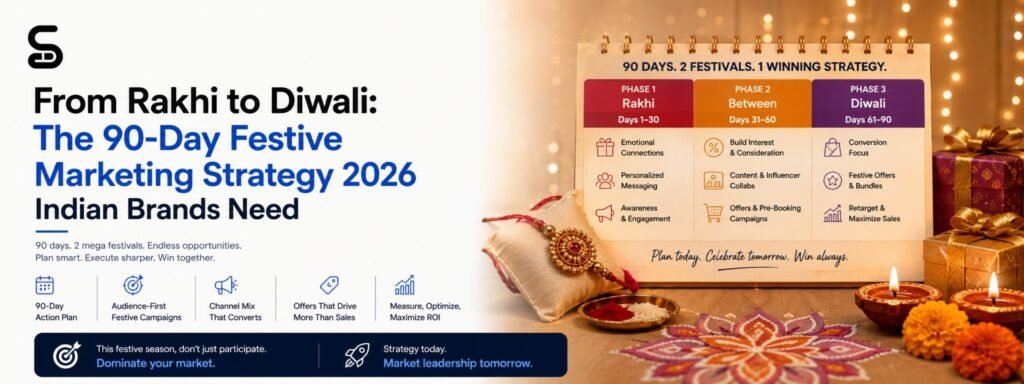
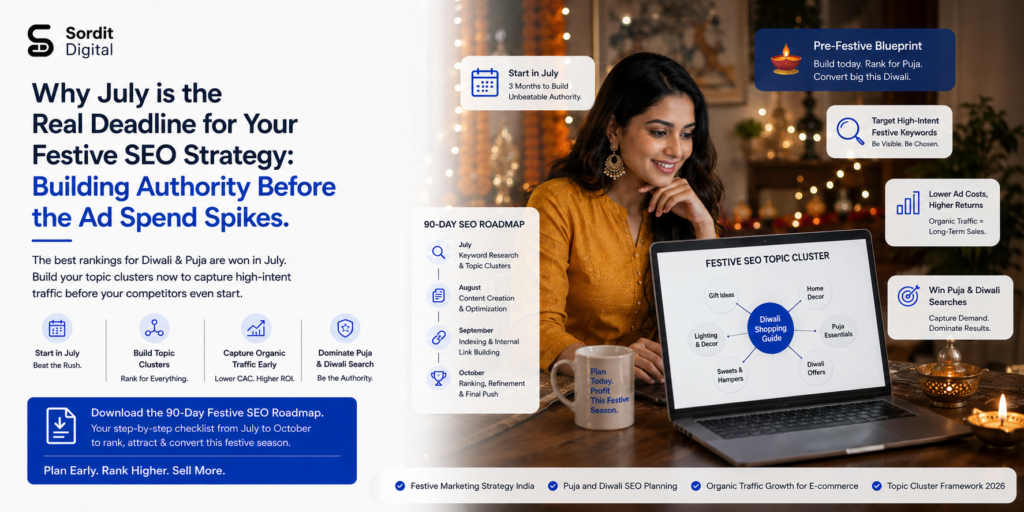
Every year, thousands of Indian retail, D2C, and B2B brands fall into the exact same trap. They wait until late September or early October—just weeks before Durga Puja and Diwali—to launch their seasonal campaigns. They throw massive budgets into Meta and Google ads, only to watch their Customer Acquisition Cost (CAC) double or triple as every competitor in India aggressively bids for the same audience. If your festive marketing strategy India relies solely on paid ads during peak festival weeks, you are burning your profit margins. In 2026, search engine indexation cycles and AI-driven answer engines demand lead time to recognize authority. Building high-converting organic visibility takes roughly 60 to 90 days. That makes July the non-negotiable deadline to build your organic search footprint. By starting your SEO foundation today, you secure prime search real estate before the paid ad bidding wars begin. 1. The Timeline Trap: Why October is Too Late for Puja and Diwali SEO Planning To understand why early execution matters, you must look at how modern search algorithms index seasonal content. Effective Puja and Diwali SEO planning isn’t about slapping “Diwali Offers” onto a page a week before the festival. It requires establishing topical authority that search engines trust implicitly. The 90-Day Organic Indexing Cycle: July: Build Topic Clusters ➔ August: Index & Gain Impression Tractions ➔ September: Pass Authority & Rank High ➔ October: Capture High-Intent Festive Traffic & Conversions When you publish a festive landing page in July: Crawl Budget Priority: Search engines have time to discover, crawl, and evaluate your content structure without competing against millions of last-minute URLs submitted in October. User Engagement Warm-up: Your pages build early behavioral signals—clicks, dwell time, and internal link traversal—signaling relevance long before commercial search volumes hit their absolute peak. Cost Neutralization: When paid ad CPMs skyrocket by 200% in October, your organic search assets continue delivering zero-cost, high-intent traffic directly to your catalog. 2. Unlocking Organic Traffic Growth for E-Commerce via Topic Clusters Modern search engines no longer evaluate isolated keywords; they evaluate comprehensive topical depth. Achieving sustainable organic traffic growth for e-commerce requires organizing your festive catalog into a clear hub-and-spoke architecture. Instead of creating one generic “Festive Offers” page, you build a structured content network: The Pillar Page (The Hub): Your master destination (e.g., “The Ultimate Festive Shopping Guide 2026”). The Cluster Pages (The Spokes): Targeted, specific sub-pages answering distinct festive search queries (e.g., “Top Corporate Diwali Gifts for Employees,” “Traditional Festive Wear Trends for Durga Puja,” or “Home Decor Hacks for Diwali”). Interlinking Signals: Every cluster page links directly back to the main Pillar page using descriptive anchor text, passing internal PageRank and proving your brand is an authority across the entire festive shopping spectrum. 3. Implementing the Topic Cluster Framework 2026 for AI Search With over 50% of search queries now interacting with AI summaries and conversational answer engines, your topic cluster framework 2026 must be machine-readable. AI agents synthesize information across multiple structured pages to generate recommendations for shoppers looking for “Best places to buy authentic ethnic wear online.” Key Optimization Steps for Your Festive Clusters: Schema Integration: Deploy OfferCatalog and ItemPage structured data across all cluster nodes to help AI crawlers understand pricing, stock status, and seasonal availability instantly. Entity Association: Connect your festive brand pages to recognized cultural entities (e.g., Durga Puja, Dhanteras, Diwali) within your JSON-LD code. Answer-First Content: Ensure every cluster article addresses common buyer questions—such as shipping deadlines, return policies, and gift packaging options—within the first two sentences of each section. 4. How Sordit Digital Architects Your Festive Dominance At Sordit Digital, we don’t believe in last-minute panic campaigns. We help Indian brands build an authoritative festive marketing strategy India during the quiet summer months, ensuring that when the multi-billion-dollar festive shopping rush hits, our clients dominate both organic search results and AI-generated shopping recommendations. By integrating technical schema, structured interlinking, and high-converting lead magnets into your July roadmap, we turn your seasonal traffic into a predictable, high-margin revenue channel. Take Action: Contact Now Don’t wait until ad costs double to plan your seasonal sales strategy. Get your organic content network indexed and ranking before your competitors even open their planning documents. The 90-Day Festive SEO Roadmap Take control of your Q3 and Q4 revenue with our chronological execution guide. This step-by-step checklist includes: July Publishing Schedule: What pillar pages and cluster topics to publish immediately. August Technical Audit Checklist: How to optimize site speed, schema markup, and internal link silos before traffic surges. September & October Conversion Hooks: Proven on-page CTAs and native chat triggers to convert festive search traffic into instant sales.  FAQs: Early Festive SEO Execution Q: Is July really necessary for a festival that happens in October or November? A: Yes. Search engines require 60 to 90 days to crawl, evaluate, and assign strong rankings to new content clusters. Publishing in July guarantees your pages reach peak authority right as consumer search volume explodes in late September. Q: How does early SEO execution impact my paid ad campaigns? A: Early Puja and Diwali SEO planning dramatically lowers your overall Customer Acquisition Cost (CAC). By capturing a large share of organic traffic, you reduce your dependency on expensive paid ad auctions during peak bidding weeks. Q: Can B2B companies benefit from a festive marketing strategy in India? A: Absolutely. B2B corporate gifting, office catering, and bulk procurement decisions are finalized by corporate HRs and procurement teams between July and August—long before the consumer shopping rush begins. Secure Your Festive Market Share Today Don’t let expensive ad auctions eat up your seasonal profits. Build your organic authority now and capture high-intent buyers before the ad spend spikes. Ready to dominate organic search this festival season with a high-performing festive marketing strategy India? Explore our specialized search frameworks on the Sordit Digital Services Page, or visit our Home Page to schedule a strategic consultation with our team today.

Digital Marketing

Instagram Indexed by Google: A Strategic Guide for Long-Term SEO Success

I. CONTEXT The Rise of Social-Search Integration The digital landscape is undergoing structural change. Once treated as distinct pillars, search and social media are now converging into a single ecosystem of brand discovery. In June 2025, Google began indexing public Instagram content—profiles, captions, and selected Reels—allowing this content to appear in Google search results. This development mirrors the broader trend seen in consumer journeys, where users toggle between platforms before making decisions. As Think with Google reports, 81% of consumers consult both search engines and social platforms before purchasing, regardless of their point of entry. This evolution makes Instagram not just a social app, but an active contributor to organic search visibility. II. THE ISSUE Traditional SEO Strategies Are No Longer Sufficient Most SEO strategies are still optimized for: Website pages   Blogs and landing pages   YouTube or Google Business Profiles   Yet, consumer engagement has shifted significantly to: Instagram   TikTok   Short-form UGC (user-generated content)   When Instagram content remains unoptimized for indexing, brands miss the opportunity to: Show up in long-tail keyword searches   Support E-E-A-T (Experience, Expertise, Authoritativeness, Trustworthiness)   Reinforce branding across organic touchpoints   In a landscape where trust and discoverability are core to conversion, siloed content strategies will no longer scale. III. STRATEGIC APPROACH Redefining SEO to Include Social Surfaces To thrive in the post-2025 digital ecosystem, brands must adopt an integrated content model that connects: Surface Role Website Core product/brand hub Google SERPs Primary discovery path Instagram Real-time storytelling, proof of credibility Blog Depth and long-form support GMB (Maps) Local trust and convenience By treating Instagram as a content node, brands increase their indexable surface area and reduce friction in search journeys. This framework leads to what we call the Visibility Triangleℱ: Search + Social + Signals = Scalable Organic Visibility IV. IMPLEMENTATION Action Plan to Align Instagram with Search Best Practices . Content Optimization Write Search-Friendly Captions Use natural language that mirrors what people actually search for. Example: Instead of “Mood 🌮”, write: “Bali beachfront villas with private plunge pools – sunset view” Use Alt Text on Every Image Instagram allows alt-text customization. Describe the image clearly with product, location, or service context. Best practice: Keep under 125 characters. Avoid keyword stuffing. Optimize Your Bio Like a Homepage Include: Primary service or product Location (if local relevance matters) Branded CTA or website link Tag Locations Strategically Location data supports local search visibility when matched with user intent (e.g. “best cafes in Jumeirah Dubai”). B. Technical Integration Embed Instagram Posts on Website This allows search engines to associate Instagram content with your domain. Link from Google Business Profile (GMB) Add Instagram as a “social link” under your Google Business Profile to connect entity signals. Cross-Reference with Structured Content Mention Instagram posts within your blogs or case studies. Use descriptive anchor text and ensure consistent metadata. C. Monitoring & Performance Tracking Metric Tool Use Indexed Instagram URLs Google Search Console Confirm crawl and visibility Instagram → Website Clicks GA4 Attribution insights Image Impressions GSC Image Search Content performance Caption Keyword Ranking Semrush/Ahrefs Track long-tail visibility shifts V. FUTURE OUTLOOK Where Social + Search Is Headed As Google’s Helpful Content System evolves, emphasis will continue shifting toward: First-hand experiences Cross-platform consistency User engagement signals (especially from social) We anticipate the following changes over the next 12–18 months: Deeper integration of Reels and short-form video into SERPs Better support for social alt-text in Google Lens and Image Search More entity-level indexing of profiles across platforms In short, Instagram is becoming part of the semantic web. Brands that treat it accordingly will not just survive algorithm updates—they’ll thrive because of them. FAQs Q1. Does Google index all Instagram content? No. Only public posts, profiles, and select Reels are indexable. Stories and private profiles are not. Q2. How do I check if my Instagram content is indexed? Use Google Search Console and inspect the URL of your profile or post. Q3. Will this help with local SEO? Yes. Posts tagged with a location and optimized with relevant captions can support local pack visibility. Q4. Should I use Instagram captions like blog content? Use them like micro-meta descriptions—natural, useful, and aligned with user intent. Avoid keyword stuffing. Conclusion The indexing of Instagram by Google is not a trend—it’s a signal. A signal that the future of SEO is multi-surface, people-first, and platform-fluid. To rank well over time: Align your Instagram with SEO fundamentals Embed it in your broader content and brand strategy Track your performance as search visibility evolves Ready to Build a Future-Proof SEO Framework? At Sordit Digital, we specialize in integrated SEO strategies that include social indexing, structured content systems, and brand-first optimization. đŸ“© Start with a free SEO + Instagram audit: hello@sorditdigital.com 🌐 www.sorditdigital.com

Digital Marketing

Google Core Update June 2025: What It Means for Your Digital Marketing Strategy

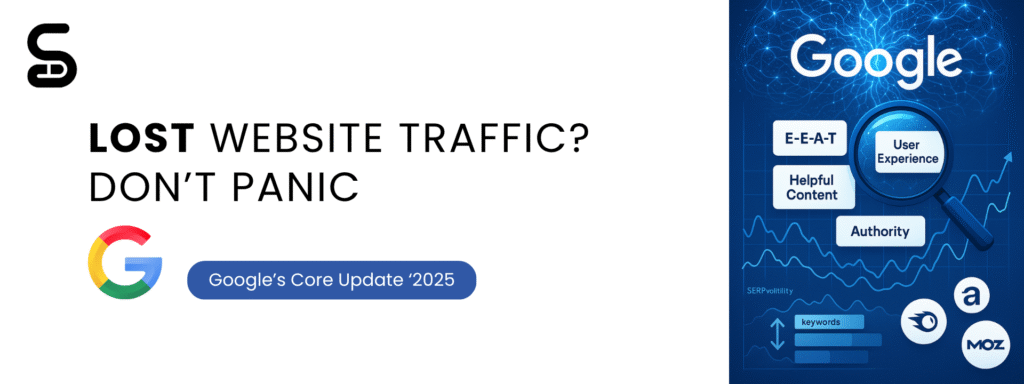
Introduction Google’s June 2025 Core Update is more than just an algorithmic refresh — it’s a wake-up call for brands and marketers to refocus on authenticity, helpfulness, and user experience. If you’re a marketing leader, startup founder, or digital strategist, understanding this update isn’t optional — it’s essential to safeguarding and scaling your online visibility. In this blog, we break down: What changed in the update How it impacts your rankings and content What research from Google, Semrush, Ahrefs, and Moz reveals Actionable steps to future-proof your digital marketing strategy TL;DR: It’s time to align your content with real people, not just search engines. What Is the Google Core Update (June 2025)? Core updates are large-scale improvements to Google’s ranking systems, aiming to present better, more helpful content to users. According to Google Search Central, the June 2025 update rolled out between June 30 and July 17, introducing refinements across: Content quality evaluation Intent-matching algorithms Trust signals based on E-E-A-T Overall user experience and SERP relevance It builds upon Google’s Helpful Content System, which prioritizes content created by people, for people — not for clicks or rankings alone. (source) Key Focus Areas of the Update 1. ✅ Elevating User Experience Google emphasized fast-loading, mobile-optimized pages, cleaner layouts, and content clarity. Websites that prioritize UI/UX saw improvements in visibility. 📈 Example: A healthcare client of Sordit Digital improved average position by 18 spots simply by decluttering mobile UX and improving readability on blog pages. 🔗 Google Page Experience Signals 2. ✅ E-E-A-T: Still the Cornerstone Google doubled down on Experience, Expertise, Authoritativeness, and Trustworthiness (E-E-A-T). According to Search Engine Journal, pages that provided real-world proof, expert bios, original research, and citations from reputable sources consistently outperformed generic or AI-spun content. 💡 What helps your E-E-A-T? Add author bylines with credentials Showcase reviews, testimonials, and case studies Use citations and links to established sources Secure your site with HTTPS and clear contact info 3. ✅ Depth Over Breadth: Content Quality > Content Quantity The update reprioritized comprehensive, insight-driven content over short or keyword-stuffed articles. This aligns with ongoing research from Ahrefs, which shows that longer, more useful pages tend to earn backlinks and rank for more keywords. 📊 Semrush’s data from July 2025 revealed that websites with topically clustered content saw up to 22% more stable rankings during and after the update. (Semrush Sensor) Impact on the SERPs: Winners vs. Losers Based on data from MozCast and Ahrefs, here’s how rankings shifted: Winners Losers Expert-written blog content with author schema AI-generated content without human editing Product pages with unique descriptions, reviews & FAQs Thin affiliate pages Local service websites with complete Google Business Profiles Generic directories with outdated info What This Means for Long-Term Digital Marketing Strategy The Google Core Update June 2025 should be a turning point for your digital roadmap. Here’s what it means practically: 🔍 Revisit Your Content Strategy Move beyond SEO checklists. Focus on content that solves real problems, adds value, and reflects your brand’s true expertise. “If you’re creating content primarily to rank in search engines, you’re doing it wrong.” – Google Helpful Content Guidelines 💡 Invest in Content That Proves Experience From how-to guides written by your internal experts to case studies, video walkthroughs, and user-generated testimonials, prioritize content that shows your real-world knowledge. 🔗 Google’s Quality Rater Guidelines (2023) 🧭 Adopt a Search Intent–First Model Use tools like Ahrefs, Semrush, and Google Search Console to map keyword queries to search intent: Informational (blog) Navigational (homepage/service) Transactional (product page) Local (GMB + landing) When your content answers user intent well, rankings follow naturally. Real-World Example: Recovery through Relevance A fintech client of Sordit Digital saw a 30% traffic drop post-update. We ran a quick recovery plan: Audited 400+ blog posts for freshness and expertise Consolidated duplicate content into in-depth guides Added certified financial expert bios to all articles Improved load speed by 1.2 seconds on mobile 📈 Result: Within 6 weeks, their top 10 keyword positions improved by 41%, with steady new leads via organic traffic. What You Can Do Today (Action Checklist) ✅ Audit your top 30 pages for: Author bios Updated stats and references Internal linking Search intent alignment ✅ Use Google Search Console to monitor traffic dips post-June 30 ✅ Create a content calendar focusing on quality and originality ✅ Refresh old posts that haven’t been updated in 18+ months ✅ Build trust signals: reviews, About Us page, case studies, media mentions Final Thoughts The Google Core Update June 2025 is clear in its message: Value real content, real experience, and real trust. Whether you’re a startup, an enterprise brand, or an agency — it’s time to think beyond keyword tricks. It’s time to think strategically about digital marketing that delivers human value. Need Help Navigating Google’s Algorithm Updates? At Sordit Digital, we specialize in helping businesses adapt to Google’s evolving standards. From content audits and E-E-A-T strategies to SERP recovery and long-term SEO planning, our team is ready to help you grow organically and sustainably. 👉 Let’s talk: Schedule a free consultation 📞 Or reach us on WhatsApp | 🌐 www.sorditdigital.com

Digital Marketing

Scaling in 2025: How Brands Can Win in India and Dubai’s Evolving Digital Marketing Landscape

The digital landscape is no longer about who spends the most—it’s about who adapts the fastest. In markets like India and Dubai, where growth, innovation, and digital adoption are surging, brands that make the right strategic moves now will lead the next wave. For marketing leaders who understand the why of digital but are looking for the right how, this blog will help you decode market trends, avoid operational pitfalls, and identify what to expect from a high-performance digital agency partnership. Why Focus on India and Dubai? India: The Growth Engine You Can’t Ignore With over 700 million internet users and a rapidly expanding Tier 2 and Tier 3 market, India is no longer an “emerging” digital economy—it’s an evolved one. The real shift? It’s not just about reach anymore—it’s about resonance. Digital ad spends in India are expected to cross INR 50,000 Cr by the end of 2025 (Dentsu 2024). Regional content now accounts for 60% of digital video consumption. Consumer journeys increasingly start on search, short video, or WhatsApp. Dubai: Digital Meets Luxury, Scale, and Speed Dubai offers a tech-forward, high-intent audience, with 99% internet penetration and a government that actively fuels innovation. With the UAE’s Vision 2031, the digital economy is projected to contribute over 20% of GDP. Consumers here expect personalization, fast UX, and elevated brand content. Influencer-led commerce is mainstream. AI, automation, and web3 experimentation is maturing. Sordit Digital operates in both markets with an insider’s understanding of regional content needs, user behavior patterns, and conversion ecosystems. What Decision-Makers Need to Know Before Scaling Digital in 2025 Most brand-side stakeholders we meet have one question: “We know what needs to be done, but how do we execute at scale without stretching internal teams?” That’s exactly where an agency like Sordit Digital becomes your execution and growth partner, not just a media vendor. Let’s break it down market-by-market—and trend-by-trend. India 2025: From Awareness to Influence What’s Changing: Consumers trust local creators over national celebrities Voice and regional search is replacing text input Short-form video is not a “trend”—it’s the homepage Where Brands Are Losing Time: Spreading efforts across too many platforms without a core funnel In-house teams spending months on production without performance ROI Relying on big-budget creative without regional relevance What You Need: Content that adapts—not just performs on TV, but converts on Instagram A SEO + content team that understands Indian search intent beyond metros Partners who can balance scale with quality (especially across languages) Dubai 2025: From Performance to Premium Positioning What’s Changing: Consumers expect brands to “show up smart” across platforms—especially Meta, Snapchat, and TikTok Influencer partnerships are built around co-creation, not just shout-outs Ad fatigue is real—brands need intelligent retargeting and deeper UX Where Brands Are Losing Time: Running one-size-fits-all campaigns for a market that values exclusivity Using performance marketing without a cohesive content narrative Working with partners unfamiliar with local culture or expectations What You Need: Localised campaigns that tap into multilingual behavior and micro-moments A performance framework that integrates organic, paid, influencer, and CRM End-to-end visibility with KPIs that are aligned with brand equity—not just CAC What to Expect from a 2025-Ready Digital Marketing Partner Whether you’re a scaling D2C brand, a lifestyle business entering the UAE, or an enterprise looking to optimize across India—your agency needs to do more than “run ads.” Here’s what you should expect from your digital partner in 2025: 1. Content that Educates and Converts Expect an agency that understands how to build trust with content before pitching a product. That means: Blogs optimized for both search and user reading depth Reels and videos with platform-native storytelling Regionally adapted, SEO-structured landing pages 2. An Integrated Funnel View You don’t need 10 different vendors for SEO, video, ads, and email. You need one team that connects the dots across: Performance (Meta, Google, YouTube) Organic (SEO, LinkedIn, Web) Conversion (CRM, landing pages, remarketing) At Sordit Digital, we provide a central strategy with decentralized execution so you can focus on leadership—not micromanagement. 3. E-E-A-T Implementation Google’s algorithm updates (like the March 2025 Core Update) are favoring brands with real Experience, Expertise, Authoritativeness, and Trust. That means your digital footprint needs: Author bios, testimonials, media mentions Localized content that shows expertise in-market Trust signals on your website, social, and ad funnels A Strategic Content & Channel Checklist (Built by Sordit Digital) Here’s what we help brands roll out as part of a market-entry or scale-up strategy: India Multilingual blogs targeting regional long-tail keywords Creator-led campaigns on Reels and Shorts WhatsApp-first communication for Tier 2+ audience Dubai English/Arabic landing pages optimized for mobile speed Influencer partnerships with audience segmentation Retargeting journeys aligned with lifestyle aspirations Final Thoughts: Choose Partners That Think Like Growth Teams Digital success in 2025 is less about tools and more about teamwork, timing, and thoughtful execution. As brand-side decision-makers, you already understand the why—you just need a partner who can execute the how—fast, flexibly, and at scale. Sordit Digital offers strategic depth, operational expertise, and cultural context across India and the UAE. We’re not just your agency—we’re your digital growth team. Want a strategy call to understand how we can plug into your brand’s 2025 roadmap? đŸ“© hello@sorditdigital.com 🌐 www.sorditdigital.com

Digital Marketing

Digital Marketing Lessons from IPL: Actionable Insights for Brands in 2025 by Sordit Digital

As brands navigate the competitive digital marketing landscape, few events offer as rich a source of insights as the Indian Premier League (IPL). IPL isn’t just the most-watched cricket tournament globally—it’s a digital marketing case study in its own right. Through innovative campaigns, fan engagement, and data-driven strategies, IPL has revolutionized how brands connect with their audience, making it a must-learn for marketers across industries. In this post, we’ll unpack actionable digital marketing lessons from IPL’s ecosystem, focusing on what businesses can learn from its strategies. These insights are based on real-world applications from IPL’s digital campaigns, verified metrics, and trends from industry leaders like Google Think Sports, Statista, BCG, and Deloitte. 🎯 1. Building Brand Identity in Real-Time: The Power of Contextual Marketing In the digital age, real-time marketing isn’t just a trend—it’s a necessity. IPL has mastered this, consistently delivering contextual marketing that resonates with both cricket fans and casual observers. Through real-time activations—from sponsored posts during power plays to branded hashtags after key moments—brands can capture attention in the moment and boost engagement significantly. According to Deloitte’s 2025 Digital Trends Report, contextual marketing is a critical strategy for brands aiming to drive relevancy in a crowded marketplace. IPL’s partnership with platforms like Twitter and Instagram, along with its use of live engagement (such as polls and instant memes), offers a goldmine of lessons on how to leverage trending moments. Key Insight for Brands: Build a strategy that allows your brand to jump on relevant, real-time trends. Whether it’s a sporting event, pop culture moment, or breaking news, being quick to respond can help create deeper connections with your audience. 🧠 2. Fan Engagement at Scale: Community-Led Content Creation The heart of IPL’s marketing success lies in its ability to build fan communities. By empowering fans to create and share content—from match-day memes to fan-made promotional videos—IPL has created a massive, organic marketing machine. As Statista reports, IPL’s social media audience is one of the largest in the world, with more than 500 million followers across platforms. This massive reach is driven by the fan-first approach that IPL teams and sponsors have adopted, turning their audience into brand advocates. Brands across industries can apply this approach by co-creating content with their audience. At Sordit Digital, we recommend leveraging user-generated content (UGC) to amplify your digital presence. Encourage your customers to share their experiences with your products, and give them a platform to become brand ambassadors. Actionable Tip for Brands: Develop campaigns that invite fans and followers to contribute their thoughts, reviews, or creative content. This not only boosts engagement but also builds a loyal, organic community around your brand. đŸ’„ 3. Omni-Channel Promotions: Reaching Consumers Where They Are In 2025, it’s clear that omni-channel marketing is the future, and IPL teams have set a perfect example of how to do this effectively. IPL integrates content across multiple channels—Instagram, Twitter, TikTok, YouTube, and even WhatsApp—creating a seamless experience for fans. According to BCG’s Sports Marketing Report, sports leagues like IPL are now leading the charge in multi-channel promotions, ensuring that their content reaches fans across every digital touchpoint. For example, IPL brands don’t just advertise on TV or digital—they integrate their message across diverse platforms, creating a cohesive, cross-platform experience that amplifies their message. For Brands: It’s no longer enough to focus on just one platform. To capture attention in 2025, businesses need to spread their marketing efforts across multiple channels and make sure their messaging aligns across each one. This means adapting your content to fit the style of each platform, from short-form video on Instagram Reels to interactive Twitter polls. 📈 4. Data-Driven Decisions: Unlocking Consumer Insights One of the most powerful lessons from IPL’s marketing is its reliance on data. By leveraging advanced analytics, IPL teams understand fan behavior and optimize their campaigns for maximum engagement. This approach has helped sponsors achieve better ROI on their digital marketing efforts. In fact, research from Google Think Sports highlights that data-driven marketing in sports helps brands achieve higher engagement rates and create more personalized content. IPL leverages data to tailor its sponsorship deals, content strategies, and engagement tactics in real-time. This allows brands to continually optimize their campaigns to drive better performance. Key Insight for Brands: Invest in advanced analytics tools to track and measure your audience’s behavior, preferences, and engagement patterns. Use these insights to continuously refine your digital marketing campaigns, ensuring greater relevance and better results. 🚀 5. Influencer Partnerships: Amplifying Brand Reach Influencer marketing has become a cornerstone of IPL’s digital marketing ecosystem. Whether it’s players promoting branded content or social media influencers creating content around match days, the IPL ecosystem has been successful in building authentic connections with millions of fans. In 2025, influencer marketing continues to be an integral part of IPL’s strategy. IPL teams collaborate with influencers to amplify their reach and create content that feels authentic to their followers. This aligns with findings from Statista, where 70% of consumers say they are more likely to purchase from brands endorsed by their favorite influencers. For brands, Sordit Digital recommends creating strategic influencer partnerships. By working with influencers who genuinely resonate with your target audience, you can increase brand visibility and drive engagement in an authentic, meaningful way. 🔑 The Takeaways for Brands Across Industries What brands can take from IPL’s digital marketing success in 2025 is clear: it’s about engagement, community, data, and relevancy. Whether you’re in sports, fashion, technology, or hospitality, these insights are universal. At Sordit Digital, we focus on leveraging the latest digital marketing strategies—backed by data and creative insights—to help brands thrive in the most competitive markets. Our expertise spans SEO, paid media, influencer marketing, and content creation—all designed to ensure your brand thrives in an increasingly crowded digital space. Learn More: Deloitte’s Digital Trends Report 2025URL: https://www2.deloitte.com/us/en/pages/technology-media-and-telecommunications/articles/digital-transformation.html BCG’s Sports Marketing InsightsURL: https://www.bcg.com/publications Google Think SportsURL: https://thinkwithgoogle.com/intl/en-apac/insights/  Statista’s Digital Marketing StatisticsURL: https://www.statista.com/statistics/ Statista’s IPL Marketing & Audience InsightsURL: https://www.statista.com/statistics/ Marketing Week: IPL Digital StrategyURL: https://www.marketingweek.com   At