

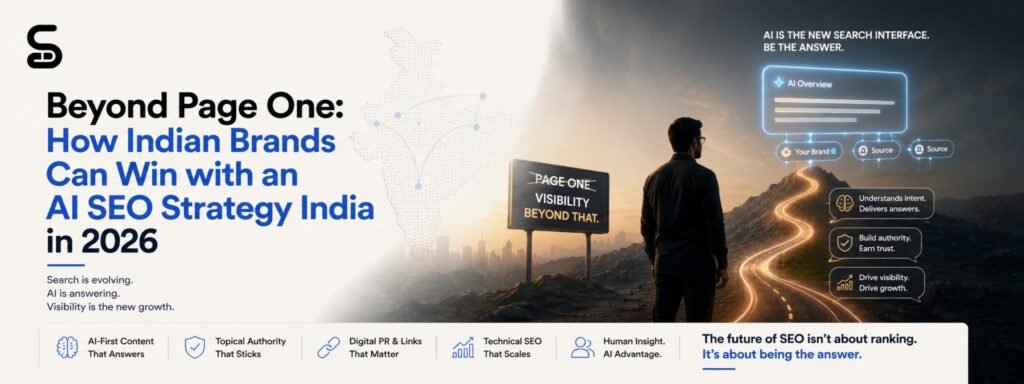
Beyond Page One: How Indian Brands Can Win with an AI SEO Strategy India in 2026
For over two decades, the formula for organic growth in India was simple: conduct keyword research, build backlinks, optimize metadata, and fight for the top spot on page one. If your URL held the #1 blue link, your pipeline was full. In August 2026, that playbook is officially obsolete. With the widespread rollout of Google AI Overviews and the conversational AI Mode tab, search engine result pages have transformed into dynamic, multi-modal synthesis engines. When a user asks a complex commercial or technical query, Google no longer serves ten isolated links—it reads the web in milliseconds, compiles a comprehensive summary, and cites a select handful of authoritative sources. If your marketing plan only measures traditional SERP rankings, you are optimizing for an invisible position. To capture high-intent buyers, modern enterprises require a forward-thinking AI SEO strategy India that focuses on machine extraction, entity credibility, and generative engine visibility. 1. The Shift to Generative Engine Optimization India: Clicks vs. Citations Traditional search engine optimization was built on direct retrieval. A user typed a query, clicked a blue link, and browsed your website. Modern search, powered by generative engine optimization India, operates on synthesis and attribution. The Evolution of Organic Search Discovery:User Query ➔ LLM Web Crawl & Information Extraction ➔ Multi-Source Synthesis ➔ AI Overview Rendered with Interactive Source Cards ➔ High-Intent User Conversion In this ecosystem, your target is no longer simply “ranking #1.” Your target is earning the Source Citation. While zero-click search behavior continues to rise for shallow, informational questions, users who click interactive AI citations display significantly higher purchase intent. Winning this traffic requires executing dedicated SEO for AI search 2026 frameworks designed specifically for Large Language Models (LLMs). 2. Optimizing for Google AI Overviews SEO: The Direct-Answer Framework Google’s neural models prioritize content that provides immediate, unambiguous value without fluff. When designing content for Google AI Overviews SEO, your page structure must cater to automated natural language extractors. The Answer-First Hierarchy: Every primary section must answer the target query within the opening two sentences. State the core takeaway immediately, then follow with data points, step-by-step methodologies, or technical explanations. High Information Density: Large Language Models favor content with a high density of unique facts per paragraph. Replace generic adjectives with proprietary metrics, verified client benchmarks, and clear operational frameworks. Modular Content Blocks: Format information using concise bullet points, structured comparison tables, and highlighted summary boxes. Modular formatting makes it frictionless for AI crawlers to extract and display your text directly inside an AI Overview. 3. Mastering AI Mode SEO Optimization for Conversational Journeys Beyond standard overviews, Google’s dedicated AI Mode allows searchers to ask follow-up questions, compare complex B2B solutions, and refine parameters conversationally. Mastering AI Mode SEO optimization means building content that anticipates the user’s second and third logical questions. Multi-Turn Query Mapping: Instead of writing single-intent articles, address adjacent considerations (e.g., implementation timelines, pricing models, common technical pitfalls, and industry-specific compliance requirements). Semantic Entity Markup: Connect your brand to verified knowledge graph entities using comprehensive JSON-LD schemas (such as Organization, Service, TechArticle, and ItemPage). Third-Party Consensus Building: Google’s generative models cross-reference information across independent platforms. Maintaining consistent brand mentions across Reddit, LinkedIn, verified directories, and industry news outlets directly strengthens your overall AI search visibility.x 4. Building Topical Authority SEO to Fuel Your AI SEO Strategy India An AI search engine will not cite a source it does not recognize as a specialized subject matter authority. To dominate your sector, you must move away from disjointed, one-off blog posts and implement an integrated topical authority SEO model. The Pillar-Cluster Blueprint for Machine Trust:Comprehensive Pillar Hub: Construct an exhaustive, multi-layered core guide that covers every operational facet of your primary service offering. Specialized Sub-Topic Spokes: Publish 5 to 10 deeply technical supporting articles that explore granular niche queries, long-tail implementation questions, and industry use cases. Strict Contextual Interlinking: Connect all spoke articles directly back to the central hub using clear, descriptive anchor text. This internal linking framework proves to search crawlers that your domain possesses complete topical depth. 5. Utilizing Google Search Console’s Generative AI Performance Reports Google has introduced dedicated Generative AI performance insights within Google Search Console. This dedicated view allows website owners to monitor impressions originating specifically from AI Overviews, AI Mode, and Discover AI features. At Sordit Digital, our technical team analyzes these generative impression streams to evaluate which URLs are successfully selected by Google’s synthesis models. By isolating high-impression, low-citation assets, we execute rapid on-page updates—refining schema markup, increasing fact density, and adding interactive elements—to convert passive AI impressions into active referral visits. 6. How Sordit Digital Drives Your AI SEO Strategy India Winning the modern search battleground requires technical sophistication, structured data precision, and authoritative copywriting. At Sordit Digital, we help Indian B2B companies, healthcare institutions, D2C brands, and professional services dominate generative search landscapes. Our comprehensive approach combines advanced technical schema mapping, entity authority optimization, and conversion-focused content architecture to ensure your brand remains the preferred citation for AI engines and executive decision-makers alike. Take Action: Download the Strategic Asset Is your website ready to be cited by the next generation of search engines? Evaluate your current organic search readiness using our internal agency audit framework. The 2026 AI Search Visibility BlueprintAccelerate your transition to generative search with our technical implementation guide: The AI Overview Citation Checklist: 12 on-page formatting adjustments to increase your citation eligibility in Google AI Overviews. Entity & Schema JSON-LD Templates: Pre-built, machine-readable structured data code snippets for service, local, and B2B brands. GSC Generative AI Tracking Guide: How to interpret Search Console’s AI performance data and identify your highest-potential citation pages. FAQs: Dominating AI Search in India Q: Does appearing in Google AI Overviews reduce website traffic?A: While general informational impressions may see lower click-through rates, users who click interactive citation links within AI Overviews exhibit substantially higher engagement, spend more time on site, and convert at higher rates. Q: Can traditional keyword research tools track AI search performance?A: Standard ranking trackers