

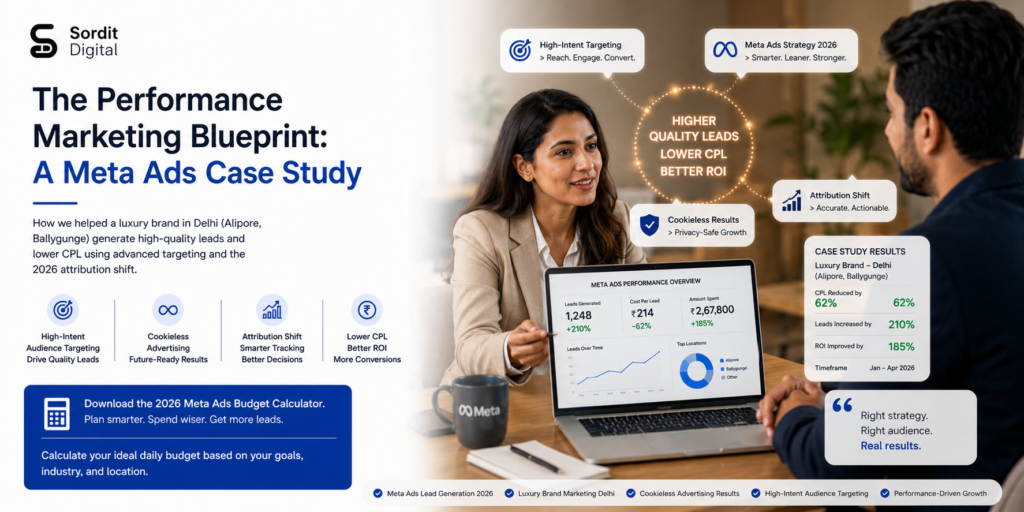
The Performance Marketing Blueprint: A Meta Ads Case Study
If you spent the early months of 2026 running Facebook and Instagram campaigns using your standard setup, you likely woke up to a severe shock. Across the industry, performance marketers watched their dashboards register a sudden, terrifying drop in conversion volumes. Overnight, Cost Per Lead (CPL) figures appeared to skyrocket, leaving agencies scrambling to explain the data collapse to frantic clients. But here is the industry secret we uncovered at Sordit Digital: the ads didn’t suddenly stop working. The way Meta measures them completely changed. Following Meta’s massive technical overhauls, the platform permanently removed legacy view windows and completely redefined what constitutes a “click.” Social interactions like likes, shares, comments, and profile visits were stripped entirely out of the click-through bucket. Instead, they were moved into a brand-new, hyper-short classification called 1-day engage-through attribution. For agencies handling high-ticket service firms or premium retail clients, this data shift initially looked like a disaster. However, by understanding these new mechanics, we transformed this reporting challenge into a competitive advantage. Here is the exact blueprint we used to execute profitable Meta ads lead generation 2026, capturing elite clients in premium geographic zones while drastically lowering our overall acquisition costs. 1. The Real-World Challenge: Luxury Brand Marketing in Elite Pockets When managing premium client accounts, traditional broad-brush targeting structures completely collapse. If you are selling premium interior remodeling, high-end design architectural services, or luxury lifestyle experiences, you aren’t hunting for high volume. You are hunting for a very specific, ultra-high-net-worth individual (UHNWI). We put our framework to the test while executing campaigns in some of the most affluent residential zones in India. Instead of targeting entire metropolitan areas, we deployed strict, precision-focused location boundary structures. We isolated our ad delivery to hyper-specific premium neighborhoods: Alipore & Ballygunge (Kolkata) Greater Kailash, Vasant Vihar, and Golf Links (Delhi) In luxury brand marketing Delhi and Kolkata ecosystems, layering generic interest tags like “Luxury Interior Design” or “Affluence” actually harms performance. Why? Because thousands of aspirational browsers, design students, and industry suppliers match those exact definitions. To win the high-ticket space in 2026, your creative must handle the filtering, while your technical structure isolates the geography. 2. Navigating the Post-Cookie Shift with High-Intent Audiences Because standard web browsers continue to block technical pixel data tracking, relying on a basic browser code snippet is equivalent to running blind. To achieve stable cookieless advertising results, we completely re-architected our data pipeline. We completely disabled the standard 1-day view attribution setting across our prospecting campaigns. In high-ticket niches, 1-day view attribution frequently creates a feedback loop where the algorithm repeatedly serves ads to a brand’s existing customers simply because they are highly likely to glance at the post. Instead, we built our optimization loops around High-Intent Audience Targeting, utilizing clean, first-party data structures: We bypassed interest stacks and leveraged server-side Conversions API (CAPI) connections to achieve an Event Match Quality score above 8.5. We fed the platform’s machine learning engine clean, encrypted offline databases containing only verified, paying customers. We instructed Meta’s AI systems to seek out lookalike profiles built exclusively from our highest lifetime-value client segments. 3. Creative Packaging: The Two-Second Filtering Rule When your target boundaries are tight, your visual assets have to perform the technical qualification. In the 2026 media environment, the average time a user spends before scrolling past a Reel or Story ad is precisely two seconds. For our luxury campaigns, we stopped producing generic, high-gloss brand montages. Instead, we deployed a native, human-led approach built around structural pattern interruption: The Immediate Local Hook: Our video assets opened instantly with localized text anchors, such as: “Planning a home renovation in Ballygunge this season?” or “The modern estate guide for homeowners in GK.” The Premium Process Video: We utilized raw, high-resolution 9:16 vertical walkthroughs showcasing real on-site material details, stone textures, and expert commentary rather than artificial stock graphics. The Friction Filter: We moved away from frictionless one-tap lead forms. We intentionally added complex qualifying fields within Meta’s native Instant Forms, forcing prospects to manually specify their project timelines and structural styles before submission. 4. The Result: Slashing CPL via Native Automation By aligning our targeting with Meta’s new 1-day engage-through parameters, our data tracking became completely transparent. We discovered that a massive percentage of our highest-quality premium leads were watching our vertical videos, saving the asset, and returning to convert via native direct message channels hours later. By building automated chat logic paths that instantly triggered when an elite prospect engaged with our creative, we eliminated website loading drop-offs entirely. We secured clean data clarity, stopped bleeding ad spend on empty, aspirational clicks, and built a consistent, repeatable system for pulling high-intent leads out of the market’s wealthiest zip codes. Take Action: Download the Asset The biggest obstacle to profitable scaling isn’t your ad copy; it is mathematical misalignment. If your daily spend parameters don’t match your industry’s average conversion timelines, your campaigns will stall in the platform’s learning phase forever. To help you structure your media investment, we have developed an interactive processing model. The 2026 Meta Ads Budget Calculator Take the guesswork out of your performance marketing. This interactive sheet allows you to input your commercial revenue targets, average deal size, and industry segment to map your required daily ad investment accurately. Learning Phase Safe-Guards: Calculate the exact baseline budget required to clear Meta’s weekly optimization thresholds. Attribution Adjusters: See how splitting your reporting between click-through and engage-through metrics impacts your actual cash ROI. Hyper-Local Scale Predictor: Model your audience saturation limits when running tight geographic constraints. FAQs: Mastering Modern Performance Media Q: What is the primary difference between a link click and an engage-through action? A: A link click represents an immediate action where a user leaves the app to visit your destination. An engage-through action captures soft social intent—saving a Reel, sharing a post, or commenting. In Meta ads lead generation 2026, tracking engage-through actions reveals hidden intent that traditional analytics platforms miss. Q: Will narrowing ad delivery to specific zip