

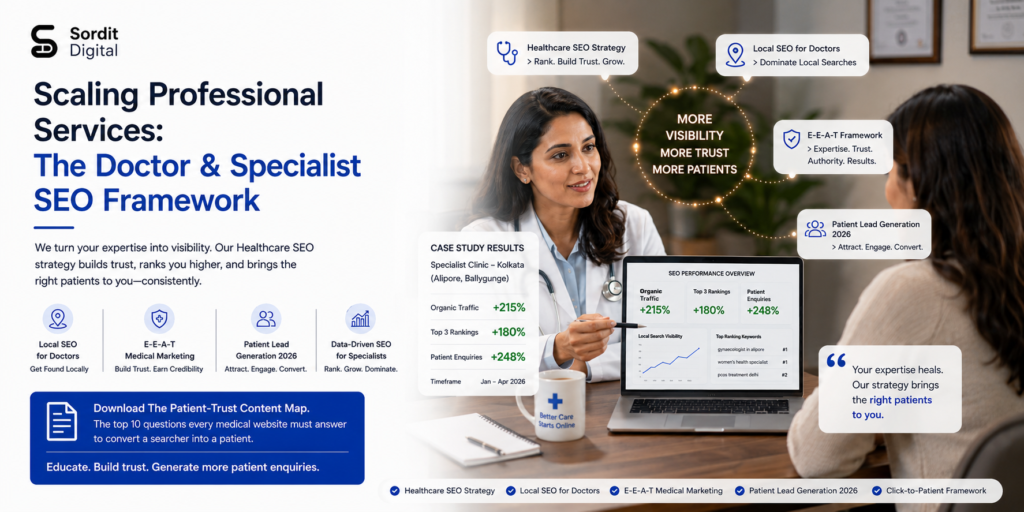
Scaling Professional Services: The Doctor & Specialist SEO Framework
When a user searches for a digital marketing agency, a low-quality blog post might cost them a few bad clicks. But when a user searches for a neurologist, a cardiologist, or a specialist clinic, the stakes are exponentially higher. Google classifies these medical searches under the strictest compliance banner in existence: YMYL (Your Money or Your Life). Because medical information directly impacts a user’s physical or mental well-being, standard keyword-stuffing strategies do not just fail—they get websites actively suppressed. Following recent core algorithm shifts, search engines have deployed highly advanced Natural Language Processing (NLP) models to evaluate medical context. To rank medical professionals in 2026, a website must prove its absolute credibility before a single patient ever steps foot inside the clinic. At Sordit Digital, we cracked the patient acquisition code by moving away from clinical jargon and building an E-E-A-T medical marketing engine. Here is the exact healthcare SEO strategy we used to turn specialized medical knowledge into a highly visible, trustworthy asset that consistently converts casual searchers into actual clinic appointments. 1. Building the E-E-A-T Medical Marketing Signal Architecture To satisfy Google’s evaluation systems, every piece of health data must carry undeniable proof of E-E-A-T (Experience, Expertise, Authoritativeness, and Trustworthiness). If a medical article appears to be written by an anonymous copywriter or a generic AI tool, its search visibility drops to zero. When structuring content for specialized healthcare entities, we execute a multi-layered verification framework: Named Professional Authorship: Every condition page, treatment guide, and symptom breakdown must be explicitly signed off by a credentialed practitioner (e.g., Dr. Shruti Kakar). Comprehensive Bio Mapping: We build robust, dedicated biography pages for every consulting specialist. These pages don’t just list their names; they link out to their National Medical Council (NMC) registration numbers, verified institutional fellowships, board certifications, and published clinical research papers. The Experience Factor: We weave real-world clinical experience into the content layout. Instead of using generic lines, our content includes specific practitioner observations: “In our clinical observation treating chronic dermatological conditions in high-humidity urban environments, we consistently observe that combining targeted topical therapies with specific lifestyle adjustments drops recurrence rates by 40%.” 2. Dominating the Map Pack: Local SEO for Doctors Over 80% of healthcare journeys begin with local search intent. Patients search for “dermatologist near me,” “best clinic in Alipore,” or “pediatrician open now.” If your medical practice does not appear within the top three local map listings next to a map, your digital visibility drops by roughly 70%. Successful local SEO for doctors requires optimization focused on micro-locations: Google Business Profile Integrity: We align the Name, Address, and Phone number (NAP) data across every directory listing. For practices with multiple physical clinics, we establish separate, unique Google Business Profiles for each campus, as a single unified listing will fail to rank in distinct geographical pockets. Hyper-Local Keyword Clusters: We build neighborhood-specific landing pages that reference nearby landmarks, primary transit hubs, and local pharmacies. This signal informs search algorithms that your clinic is highly convenient to patients living within that specific geographic radius. Sentiment and Attribute Scoping: Modern search engines crawl user reviews to extract specific contextual indicators. We help practices implement compliant internal review collection workflows. When multiple verified patients naturally state that a clinic provides “the best treatment for chronic migraine,” search algorithms automatically elevate that practice for matching informational inquiries within that local territory. 3. High-Conversion Patient Lead Generation 2026 Attracting traffic to a healthcare page is only half the battle. A successful medical marketing campaign must convert that attention into a booked appointment. The primary reason medical websites maintain high traffic but single-digit bookings is a fundamental lack of trust on the landing page. To achieve consistent patient lead generation 2026, your landing pages must act as a seamless, empathetic digital front desk: The Answer-First Layout: Patients researching symptoms are often anxious. Your pages must answer their core question within the first two sentences of the heading. Providing rapid clarity reduces page bounce rates and positions your brand as a helpful authority. Transparent Access Points: Ensure click-to-call numbers, direct WhatsApp chat routing, and live booking calendar modules are permanently fixed to the mobile navigation dock. Clinical Privacy Compliance: Ensure your server architectures are secure, utilizing encrypted data transfers and explicit patient privacy disclaimers on all intake forms. Demonstrating security is critical for both patient peace of mind and search evaluation scores. 4. Technical Infrastructure for Machine Readability Before an AI search summary or a search engine crawler can recommend your medical practice, it must translate your site’s data structure flawlessly. We implement deep, structured data layouts on every healthcare asset we manage. We map out extensive JSON-LD schema strings that explicitly state the clinic’s operating metrics to search crawlers: MedicalOrganization and Physician schema variables to declare specific clinic departments, medical degrees, and institutional memberships. MedicalCondition and MedicalProcedure markers to tie your educational content directly to recognized medical classifications. FAQPage structures to feed direct questions and answers cleanly into modern AI search summaries. Take Action: Download the Asset The bridge between a casual online search and an active patient booking is built entirely on clinical trust. If your medical content reads like a sterile textbook, prospects will back out and find a practitioner who speaks to them directly. To help you evaluate your patient-facing assets, we have mapped our internal content framework. The Patient-Trust Content Map Stop losing local patients to generic directory platforms. This strategic blueprint highlights the top 10 psychological, technical, and medical questions your website must answer immediately to dismantle user hesitation and secure the appointment booking. The E-E-A-T Core Matrix: Discover how to layout your specialist bio pages to maximize algorithm trust scores. Anxiety-Reduction Writing Models: Master the conversational, answer-first copywriting structures that build immediate patient rapport. The Local Visibility Checklist: Learn the exact adjustments needed to push your clinic into your neighborhood’s top 3 map results. FAQs: Navigating Healthcare Compliance & Rankings Q: How long does a healthcare SEO strategy take to show actual patient booking growth?