

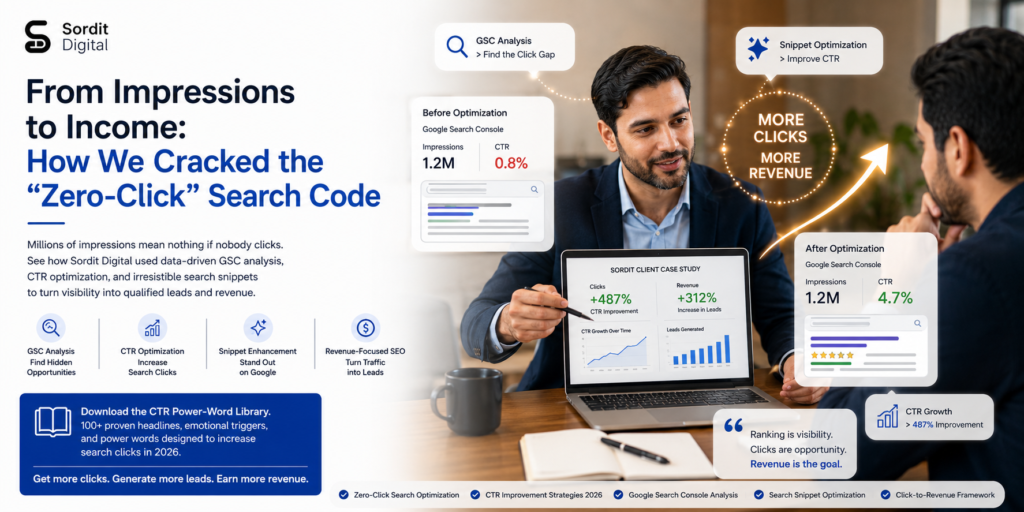
From Impressions to Income: How We Cracked the “Zero-Click” Search Code
It is the most frustrating dashboard view in modern digital marketing. You log into your analytics, look at your search performance, and see a beautiful, skyrocketing mountain of Impressions. Your brand is appearing in front of thousands of eyes. Yet, when you look at your Clicks, the line is completely flat. You went from 0 clicks to 4 clicks in a month. Meanwhile, your brand visibility is at an all-time high. What is going on? Welcome to the reality of zero-click search optimization in 2026. According to the latest large-scale search engine studies, an astonishing 68% of Google searches now end without a single click to the open web. Between AI Overviews, rich snippets, and Google’s aggressive push to keep users inside its own walled garden, your website is no longer just competing with rival agencies—it is competing with the search engine itself. At Sordit Digital, we refused to accept that impressions are “the new clicks.” We went to work to crack the code, using our own local client data as a testing ground. Here is exactly how we turned ghost visibility into high-value website traffic. 1. The Diagnostic Stage: Google Search Console (GSC) Analysis You cannot fix a click leak until you know exactly where the pipe is broken. Every successful CTR recovery plan begins with a deep, uncompromising Google Search Console (GSC) analysis. Most marketers look at GSC and only check their average position. In 2026, that metric is deeply misleading. A page ranking at Position 2 for a keyword that triggers a massive, interactive AI Summary will inherently have a lower Click-Through Rate than a page ranking at Position 4 on a clean, traditional search page. To isolate our low-performing assets, we executed a simple filtration framework within GSC: We pulled 90 days of performance data and navigated directly to the Pages tab. We sorted the layout by Impressions to identify our highest-visibility URLs. We flagged every page that retained thousands of impressions but generated a CTR below 1%. This diagnostic process immediately revealed our lowest-hanging fruit: pages that Google deemed incredibly relevant, but users found entirely uncompelling. 2. The Solution: Search Result Snippet Optimization Once our target pages were isolated, we shifted our focus to search result snippet optimization. If a user looks at your search listing and decides not to click, your snippet has failed to build curiosity. It gave away too much, or it gave away nothing at all. In the era of AI summaries, your meta metadata must perform like a high-converting ad copy. We completely re-architected our clients’ snippets using three core 2026 data rules: The Curiosity Gap: If your meta description completely answers a factual question (e.g., “Our agency setup fee is ₹25,000”), the user gets their answer on Google and leaves. Instead, construct a gap: “Discover the exact framework we used to slash client setup costs by 40% while doubling output. See the full breakdown.” Brackets and Visual Anchors: The human eye scans search results rapidly. By adding structural tags like [2026 Framework] or [Step-by-Step Template] to the front of our Title Tags, we created immediate visual separation from flat text listings. FAQ Schema Real Estate: We injected valid FAQ structured data directly into the backend of our high-impression service pages. This forced Google to render expandable question drop-downs beneath our listings, physically doubling our visual size on the search results page. 3. Case Study: Turning Impressions into Income for Kolkata Brands To prove our framework, we applied these exact CTR improvement strategies 2026 to a local high-ticket service client facing the identical issue: massive local impressions, but single-digit weekly click counts. We discovered that their primary informational pages were being completely cannibalized by Google’s instant answer boxes. We executed a rapid on-page shift. We added a highly visible, high-contrast Interactive Tool (a cost estimator) near the top of the page and modified the search snippet to highlight it: [Interactive Tool] Calculate Your Exact Cost Instantly. Because an AI summary cannot simulate an interactive calculator, users were forced to click through to use the tool. Within 30 days of executing this adjustment, the client’s organic traffic surged, turning empty impressions into a steady stream of local contract inquiries. 4. The “Authenticity Premium” to Push the Click There is an underlying psychological factor behind the 2026 click shortage: AI Content Fatigue. Searchers are visually exhausted by search listings that read like robotic manuals. To break through this barrier, we injected first-person perspective into our titles. Instead of using sterile headlines like “Top B2B Digital Marketing Tactics,” we adjusted our positioning to “Tested by Our Team: What Actually Works for B2B Lead Gen in 2026.” This direct, human-to-human (H2H) validation signals immediate authority. It promises the searcher that if they take the time to click, they will find real-world execution, not synthetic fluff. Take Action: Download the Asset The difference between a 0.5% CTR and a 3.5% CTR is the difference between an empty pipeline and a scaling business—without spending an extra rupee on ads or content creation. To help you rewrite your underperforming listings, we’ve packaged our internal copywriting framework into an actionable file. The CTR Power-Word Library Stop letting search engines keep your hard-earned traffic. This comprehensive guide contains over 100 high-converting headlines, visual formatting templates, and psychological triggers specifically engineered to bypass zero-click roadblocks. Curiosity Starters: Learn how to write metadata that teases the solution without giving it away on the SERP. Bracket Templates: Discover the highest-performing visual tags for B2B, local retail, and healthcare niches. Action CTAs: Master the exact phrases that compel a user to stop scrolling and start clicking. FAQs: Overcoming Zero-Click Obstacles Q: Can a website still grow traffic if zero-click searches are rising globally? A: Absolutely. While informational queries are heavily cannibalized by AI, transactional, local, and brand-specific searches still drive massive click volumes. Winning requires focusing your zero-click search optimization on high-intent keywords. Q: How do I know if an AI Overview is stealing my traffic? A: Run a thorough Google Search