

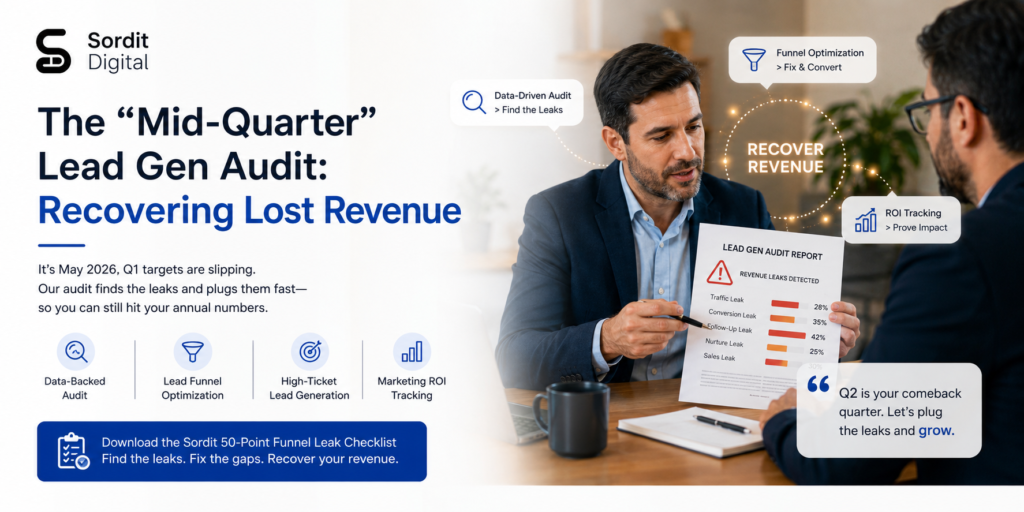
The Mid-Quarter Lead Gen Audit: Recovering Lost Revenue Before Q1 Slips Away
It is May 2026. The new financial year kicked off last month with ambitious targets, fresh budgets, and high expectations. Yet, as mid-May arrives, many B2B owners, founders, and corporate executives are looking at their dashboards with a growing sense of unease. The high impressions are there, but the actual conversion volume feels sluggish.If your pipeline isn’t matching your projections, you are facing a critical mid-quarter bottleneck. Waiting until June to fix a broken funnel means discarding an entire quarter of revenue. To reverse this trend, you need an immediate, structural evaluation. Implementing a comprehensive digital marketing audit for businesses is your strategic rescue plan to identify hidden pipeline friction, optimize your media spend, and secure your financial goals. 1. Spotting the Flaws in High-Ticket Lead Generation 2026 The customer acquisition landscape has shifted dramatically this year. With the widespread adoption of AI-driven search models and automated privacy frameworks, legacy funnels are bleeding capital. If your enterprise relies on high-ticket lead generation 2026, standard traffic metrics can easily mislead you. Many brands experience high ad impressions and stable visibility, yet their actual sales pipeline remains stagnant. This disconnect usually happens because the initial ad creative is broad, which attracts casual browsers rather than qualified decision-makers. A precise marketing evaluation analyzes user intent at the very first touchpoint, ensuring your messaging addresses complex business requirements rather than generating empty metrics. 2. Resolving the Tracking Chaos: Modern Marketing ROI Tracking If your team is still calculating marketing success by looking at isolated platform metrics, your budget allocation is flawed. Following recent technical tracking overhauls on major ad networks, tracking user pathways across multiple domains has become increasingly complex. Accurate marketing ROI tracking now demands a server-to-server data architecture. During our strategic technical evaluations, we frequently find that up to 30% of high-value conversions fail to report correctly via standard browser pixels. This tracking blind spot means your ad accounts are optimizing for the wrong user actions, driving up your acquisition costs. Restoring clear data pipeline visibility ensures your capital is directed toward the ad variations that generate actual pipeline revenue. 3. Systematic Lead Funnel Optimization An effective commercial pipeline must act as a seamless journey, guiding a user from initial brand discovery straight to a scheduled consultation. Unfortunately, friction points often emerge where platforms intersect. To execute successful lead funnel optimization, your team must audit the entire customer journey: The Content Handoff: Ensure your ad copy transitions smoothly to your landing page messaging without any confusing changes in tone or perspective. The Conversion Friction: Evaluate your inquiry forms. Requesting too much information on an initial touchpoint can destroy your conversion rates. The Response Velocity: In 2026, an inquiry left unanswered for more than fifteen minutes loses 80% of its conversion potential. Incorporating automated, high-end messaging workflows can keep your prospects warm until your sales team steps in. 4. The Sordit Digital Diagnostic Approach At Sordit Digital, we do not believe in generic optimization advice. Our specialized evaluation dissects your digital infrastructure into actionable data points. We evaluate your server performance, inspect your advanced schema layouts for AI readability, and map your first-party data capture systems. Fixing a low-performing campaign requires looking beyond superficial metrics. It requires analyzing the technical foundation, the message positioning, and the data delivery systems to build a predictable engine for your business. Take Action: Download the Asset Identifying where your marketing pipeline is leaking data and revenue can be challenging without a structured framework. To help you evaluate your current setup, we have compiled our internal agency framework into a practical tool. The Sordit 50-Point Funnel Leak Checklist Stop guessing why your impressions aren’t turning into closed contracts. This comprehensive diagnostic blueprint walks you through our complete technical, creative, and data infrastructure audit process. Technical Audit: Verify your server response times, data pathways, and tracking health. Creative Evaluation: Analyze your message positioning and short-form visual asset hooks. Data Structure Mapping: Confirm your first-party database compilation and automated workflow readiness. FAQs: Mid-Quarter Pipeline Optimization Q: How often should an enterprise run a complete marketing evaluation? A: A comprehensive digital marketing audit for businesses should be performed at least twice a year. However, light performance audits should occur mid-quarter to protect your capital. Q: Why is our acquisition cost rising even though our ad creative remains unchanged? A: Audience saturation and ad fatigue occur rapidly in modern digital channels. If your creative assets don’t feature clear hooks or persona-specific targeting, platform algorithms will widen your delivery, driving up your costs. Q: Can native platform automation really improve our lead quality? A: Absolutely. Utilizing native message funnels keeps prospects inside their preferred environments, eliminating website loading delays and significantly lowering drop-off rates. Secure Your Financial Growth Do not let a slow start in April compromise your entire year. Partner with an agency that focuses on measurable pipeline growth, transparent data infrastructure, and authentic communication strategies. Ready to eliminate your pipeline friction? Head over to our Marketing Audit Page to see how we build high-converting acquisition engines, or return to our Home Page to schedule your private strategic consultation today.